
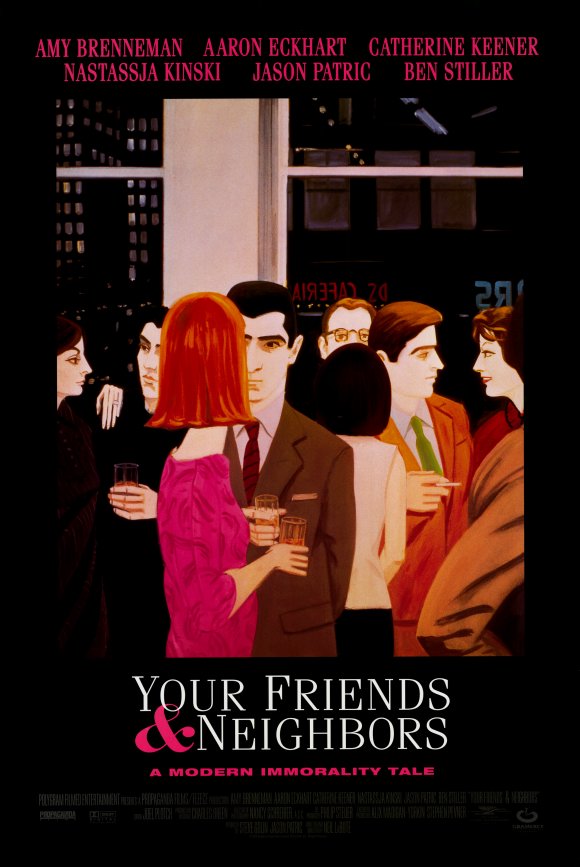
Your Friends and Neighbours looks at the lives of 6 people and finds themes of anger, repression, denial, indifference, selfishness and downright cruelty. It's a comedy. If it's title weren't so fucking sarcastic it would play like a tragedy of pompous, high class, human waste. Instead it's a pernicious and hilarious indictment of these sad sack New York City assholes.
That people like this exist is the tragedy. That writer/director/adaptor-of-his-own-stage-play Neil Labute exposes their truly ugly natures and revels in how rightfully they deserve one another to the absolute bitter fucking end results in a savage comedy. In Labute's world, we are most definitely laughing at you, not with you.
Because Your Friends and Neighbours is essentially filmed theatre (Labute is certainly more comfortable with his words and as director doesn't do much but film them), and because theatre likes to find themes inside of character, the best way to approach it is probably to break them down individually.

Ben Stiller plays Jerry, an insecure dramatic arts professor who has a flair for Greek tragedy and is better suited to be teaching about the raw, hard sex of his most beloved works than the limp, wheezing train wreck that is his sex life. Jerry has a severe case of mental little dick syndrome. He's prone to over-analysis of everything that enters his mind, making everything that surrounds him into a grand study of complex artistic discourse. Even during sex he'd rather yammer on out loud than simply get it up and get down. It's a lonely world for a man who values the challenges of great art and literature over that of true human emotion.

He's with Terri (Catherine Keener, brilliant as always) a writer who's menial job involves writing captions on the sides of display boxes for grocery store products. She's cold, fancies herself, as most failing writers do, as an unrecognized genius, sees right through Jerry and his histrionic academic bullshit and hates him for his success. She also wishes everyone around her would just shut the fuck up so she can be left alone to think. It's a lonely world for an intelligent woman who is emotionally inert and fancies herself smarter and more deserving of grand recognition than everyone she meets. That Labute manages to drop one of the best uses of the word "cunt" in cinema at her expense is no real surprise, if you catch my drift.

Jerry's best friend is Barry (Aaron Eckhart), a bloated businessman with a married-douche-bag moustache, who classifies his best sex as being with himself. This explains why he can't get it up for his wife who lays, night after night, facing away from him as he cuddles her desperately close, making the same bullshit excuses as to why it wasn't any good again. Until, of course, she falls asleep and he can tug one off beside her. It's a lonely world for a man who's never been jerked off better by anyone but himself as he clings to a the safe haven of marriage so he won't need to recognize what a selfish pig he is.

That wife is Mary (Amy Brenneman), an average woman who thinks she desperately wants to be fucked, hard, by a man who is not her cowardly, insecure, self absorbed husband. Maybe that's why she agrees to a proposed affair with Jerry, leading to one of the film's many cruel and hilarious set-ups and pay offs. It's a lonely world for a plain, married women who can't even get the man she is committed to until death do them part to pay attention to her other than to make excuses as to why they don't have a serious problem.

Best friends to Barry is Cary (Jason Patric in the performance of a career). Cary is the epitome of Labute's favourite kind of character: smart, strikingly attractive, oozing animal magnetism and completely emotionally turned off from the world. Cary has the brain and the will to destroy just about anyone upon initial contact. He's already got you pegged after but a few words have been exchanged and will use this to decide your fate in his presence. He's the form of playboy that would, many years later, be muted and transformed into a lovable sitcom character in the form of Barney Stinson.

Patrick's scene in a sauna in which he is asked to describe his best sex is horrifying, hypnotic and hilarious all at once. And all delivered in one incredible unbroken take as the camera slowly creeps into a powerful close-up.
Labute, like the best playwrights, knows how to balance the grey areas of the emotional spectrum perfectly. We don't like these people, but we aren't asked to feel sorry for them either. They deserve whatever cruelty the universe throws at them and Labute allows the savage in us take pleasure in laughing at their ignorance, selfishness and misfortune. Redemption isn't even an option in Labute's world. If you're born this way, chances are you'll fucking well die that way too.

There is a 6th key role, Cheri (Nastassja Kinski) who approaches each character separately in the same art gallery, while they are looking at the same painting. The conversation is always the same. These people are interchangeable, their names all rhyme, they all think the same, behave the same and in a cruel twist of irony, have the same fucking problem: they are all too wrapped up in themselves to even fathom the possibility of someone else in this world being their equal. Lonely is the world indeed.
On second thought, maybe this is a tragedy after all?

