

I don't really follow so I'm not so sure if it's the case anymore but once upon a time one of the big arguments against the legalization of marijuana is that it is a gateway drug. Once you have become accustomed to the high that smoking pot comes with it opens the mind up to trying other, more stronger highs. Once you've driven 110 on the expressway, why not try 120 as well? And so forth.
In that sense, based on that argument, marijuana is an introduction to drug use: the first step on a path to other things (ed: I am not, of course, making any kind of comment on how much I agree or reject this argument).
There are certain movies that act in the same way: They are the first step into exploring greater, more sophisticated, deeper filmic experiences. Some of them are good in their own right, many of them have achieved a cult status, a couple are unjustly praised by those who are using them as their gateway because they don't know any better and so on. Quality hardly matters in such a case as long as they serve their specific purpose.
Now that I've laid out the foundations let me lead with some examples: The Usual Suspects is a gateway to the classic noir of Double Indemnity or Out of the Past; Pulp Fiction is the gateway to the highly stylised and homage friendly cultural hipness of early Godard like Breathless and Band of Outsiders; Fight Club is the gateway to experimental film-as-state-of-mind works like After Hours, Goodfellas is the gateway to more under appreciated Scorsese classics; Donnie Darko is the gateway to more obscure movies that actually know what they are about; Inception is the gateway to great science fiction like 2001: A Space Odyssey and even the films of David Lynch are a cross between the surrealism of Luis Bunuel mixed with the Hollywood cynicism of Billy Wilder. And so on down the line.
Is it ironic that they are all American movies? Maybe it is. Whenever, after all, we see a bland European movie it feels too "Americanized." But that's not the point I don't think. The vast majority of film goers learn the trade off of American movies. They strike a nice balance between trying to be (sometimes at least) hip and original while also trying to be popular and profitable (Scorcese, Tarantino, Forester, Soderberg and so on all fall into this category).
Some people, of course, will never get beyond this stage. Some are content not pushing the horizons, not being introduced to new forms of expression, culture, history or society. Fair enough. But if they ever choose, there's a whole new arena of things to experience after the baby steps.
Other Filmic Measures:
Chocolate Bar Movies
Where's the Airship Movies
Monday Movies
The Documentary Rule


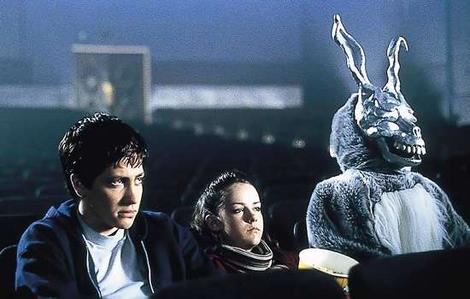 The first time I saw Donnie Darko was when it first came out on VHS. A couple of DVD's were around at that time but the technology was just emerging and certainly too expensive for my family to invest in at that point, which was fine with me as I am generally not well receptive to change. I had no idea what the movie was at the time other than that I had seen a preview for it on some other VHS I had recently rented and thought it looked alright. That of course was the sweet summer between grade 10 and 11 when I would watch anything that had a cool enough video box regardless of whether it was released theatrically or straight-to-video. I had already gotten into writing reviews at this time and had made the decision that one day I would be a professional critic (I think my original review still exists on IMDB somewhere, spelling mistakes and all).
What played before me, at the time, I considered an act of absolute brilliance. Of course, back then, when you're young and think you know something about something, Donnie Darko was just the thing I needed. Here I was, 16 or somewhere there around, working the film out over and over in my head, connecting the dots, making huge, brilliant discoveries about life and love and fear and death. I thought I had seen a masterpiece.
Soon after I got a DVD player and slowly started collecting them. Donnie Darko was one of my first purchases. I intended to watch it over and over and over again in my lifetime.
I just watched Donnie Darko for the second time tonight, Saturday February 27, 2010. I watched it because I want to sell off some DVDs and thought it might be one of them. Over the span on those years I've grown. I now hold a major in Film Studies, I've had reviews published and presented at a prestigious film conference, I've even gotten an e mail from Roger Ebert complimenting my writing, and, most importantly, I've watched some of the greatest films ever made.
Needless to say I don't feel the same about Donnie Darko. One of us apparently hasn't aged well. I can admire the craft of it's making, the professionalism of it's performances, but now I've learned that ideas are not what makes a film great or not, it's how it goes about presenting them (Roger Ebert once said, "It's not what a film is about that makes it good or not. It's how it's about it."), and an over-emphasis on film style doesn't impress me nearly as much as it once did.
In reality, Donnie Darko is one of those stepping stone pictures. Like Fight Club, The Boondock Saints or The Usual Suspects, to name a few, young people discover them and latch on to them because they are like nothing they have ever seen before. Every independent thinking, individualistic teenager wants to have something that they can hold above everyone else; something that speaks to them in volumes that their brainless colleagues could never comprehend, until they grow up, see more movies (better movies), and finally realize that those films are no more than empty-headed and empty-hearted excursions into style, with shallow philosophies that serve only themselves, not the stories.
That was Donnie Darko to me. I'm glad I got out of that stage. Some people never do. I think Kevin Smith said it best on one of his Evening With... DVDs when he made the comment that not even writer/director Richard Kelly knows what Donnie Darko is about. The comment was in jest but that basically sums it up. Kelly has no overarching approach to this material. He has no one specific thing he is trying to say, so he says them all and hopes maybe one or two stick.
I know, I know there's all this contradictory imagery that shows the duality of the human psyche, and I get that, but so what? Does that automatically make the movie good? What does it have to do with time travel? By the time the movie rolls around into it's third act and starts looping back upon time and upon itself and we are treated to a conclusion that is more ironic than anything, you finally see what Kelly's point was: to try to hold this thing together for just under 2 hours. That he does it is commendable. But it still doesn't make the movie a success.
To put imagery in a movie and assume it speaks for itself isn't enough. The golden rule of style is that form must equal function. You cannot separate the story from the style. As Godard once said, they create each other. That's the mistake Donnie Darko makes: it doesn't provide an adequate story to back up it's symbolism. I can see why a lot of kids would connect with Donnie Darko. He's a depressed, dissatisfied youth, wandering through life just trying to find something meaningful. I obviously connected with that once upon a time myself. Now though, his journey just seems in vein because Kelly doesn't allow him to find that meaning. At the end, Darko isn't a kid on the verge of grand epiphany, he's just some character in some minor, hip indie flick that goes through the motions of being some character in some minor, hip indie flick. And that's about it really.
The first time I saw Donnie Darko was when it first came out on VHS. A couple of DVD's were around at that time but the technology was just emerging and certainly too expensive for my family to invest in at that point, which was fine with me as I am generally not well receptive to change. I had no idea what the movie was at the time other than that I had seen a preview for it on some other VHS I had recently rented and thought it looked alright. That of course was the sweet summer between grade 10 and 11 when I would watch anything that had a cool enough video box regardless of whether it was released theatrically or straight-to-video. I had already gotten into writing reviews at this time and had made the decision that one day I would be a professional critic (I think my original review still exists on IMDB somewhere, spelling mistakes and all).
What played before me, at the time, I considered an act of absolute brilliance. Of course, back then, when you're young and think you know something about something, Donnie Darko was just the thing I needed. Here I was, 16 or somewhere there around, working the film out over and over in my head, connecting the dots, making huge, brilliant discoveries about life and love and fear and death. I thought I had seen a masterpiece.
Soon after I got a DVD player and slowly started collecting them. Donnie Darko was one of my first purchases. I intended to watch it over and over and over again in my lifetime.
I just watched Donnie Darko for the second time tonight, Saturday February 27, 2010. I watched it because I want to sell off some DVDs and thought it might be one of them. Over the span on those years I've grown. I now hold a major in Film Studies, I've had reviews published and presented at a prestigious film conference, I've even gotten an e mail from Roger Ebert complimenting my writing, and, most importantly, I've watched some of the greatest films ever made.
Needless to say I don't feel the same about Donnie Darko. One of us apparently hasn't aged well. I can admire the craft of it's making, the professionalism of it's performances, but now I've learned that ideas are not what makes a film great or not, it's how it goes about presenting them (Roger Ebert once said, "It's not what a film is about that makes it good or not. It's how it's about it."), and an over-emphasis on film style doesn't impress me nearly as much as it once did.
In reality, Donnie Darko is one of those stepping stone pictures. Like Fight Club, The Boondock Saints or The Usual Suspects, to name a few, young people discover them and latch on to them because they are like nothing they have ever seen before. Every independent thinking, individualistic teenager wants to have something that they can hold above everyone else; something that speaks to them in volumes that their brainless colleagues could never comprehend, until they grow up, see more movies (better movies), and finally realize that those films are no more than empty-headed and empty-hearted excursions into style, with shallow philosophies that serve only themselves, not the stories.
That was Donnie Darko to me. I'm glad I got out of that stage. Some people never do. I think Kevin Smith said it best on one of his Evening With... DVDs when he made the comment that not even writer/director Richard Kelly knows what Donnie Darko is about. The comment was in jest but that basically sums it up. Kelly has no overarching approach to this material. He has no one specific thing he is trying to say, so he says them all and hopes maybe one or two stick.
I know, I know there's all this contradictory imagery that shows the duality of the human psyche, and I get that, but so what? Does that automatically make the movie good? What does it have to do with time travel? By the time the movie rolls around into it's third act and starts looping back upon time and upon itself and we are treated to a conclusion that is more ironic than anything, you finally see what Kelly's point was: to try to hold this thing together for just under 2 hours. That he does it is commendable. But it still doesn't make the movie a success.
To put imagery in a movie and assume it speaks for itself isn't enough. The golden rule of style is that form must equal function. You cannot separate the story from the style. As Godard once said, they create each other. That's the mistake Donnie Darko makes: it doesn't provide an adequate story to back up it's symbolism. I can see why a lot of kids would connect with Donnie Darko. He's a depressed, dissatisfied youth, wandering through life just trying to find something meaningful. I obviously connected with that once upon a time myself. Now though, his journey just seems in vein because Kelly doesn't allow him to find that meaning. At the end, Darko isn't a kid on the verge of grand epiphany, he's just some character in some minor, hip indie flick that goes through the motions of being some character in some minor, hip indie flick. And that's about it really.