Showing posts with label Midnight in Paris. Show all posts

Monday, December 5, 2011

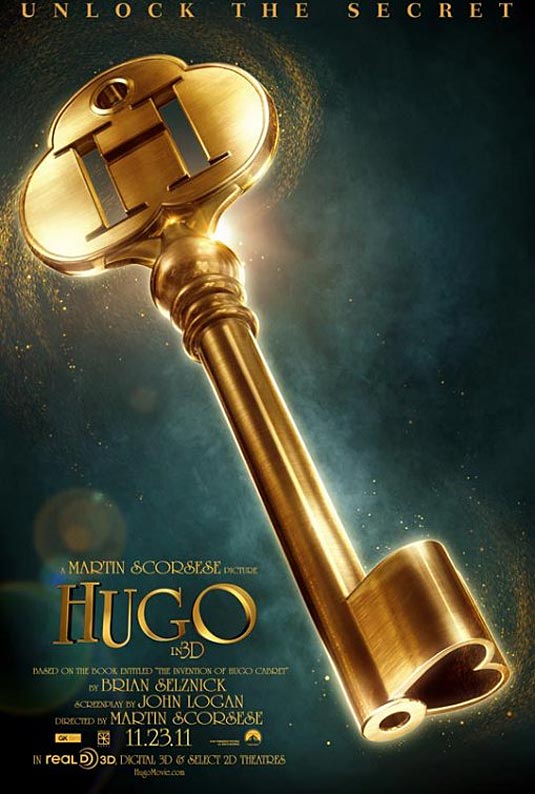
Hugo

At the age of 69 Martin Scorsese will direct films after Hugo. Some of them, if not most of them, will be great and some of them may even still be on the lips of many long after both America’s greatest living filmmaker has passed on and the sound of Hugo has gone silent. But it’s safe to say that, no matter how many films are still to come from Scorsese, and no matter their quality, none of them will be as beautiful, touching or personal as Hugo. Martin Scorsese has, one film at a time, become the very definition of American film. But he’s no longer that young kid from New York trying to push boundaries and change the landscape of film as we know it. He’s already been there and done that. Now he’s that wise old man, none of the ambition or vision having faded, who looks back at it all and sees just what it has meant. There will not, I think it’s fairly safe to say, be a more magical film released in 2011 than Hugo.

Disguised in the veil of grand family adventure, Hugo is a film that tells the tale of a young boy in Paris. His father (Jude Law) was a clockmaker who loved to tinker and fix things. Together they fixed old gizmos, so primitive by today’s standards that it’s a marvel they even worked at all, went to the movies, and loved each other very much. The father’s swan song was to be fixing up an old mechanical man called an Automaton. These were essentially life-like wind up toys designed to, when wound, perform human tasks. When Hugo’s father finds an old one forgotten in a museum he brings it home to fix. This one is a writer, but before it can again put pen to page an accident happens and Hugo is left an orphan.

He’s taken in by his alcoholic uncle Claude (Ray Winstone) whose job it is to see that all the clocks at the local train station are in working order. Once the boy is taught how to operate the clocks he is left alone to perform the man’s duties and continue fixing the Automaton while constantly evading the pursuits of the Chaplinesque Station Inspector (Sacha Baron Cohen) who hates orphans.

In order to fix the Automaton, Hugo begins stealing parts from George (Ben Kingsly) an old man who owns a meagre toy shop in the station. When George catches Hugo in the act he takes the boy’s notebook, the contents of which, mysteriously upset him. Hugo enlists the help of George’s adopted god daughter Isabelle (Chloe Grace Mortez) who is an avid reader, has never seen a movie and is looking desperately for a real life adventure.

Scorsese and his writer John Logan, like master storytellers, allow this story to unfold gradually, not revealing all of its secrets up front. This allows the revelation of George’s true identity and the children’s quest to find the missing pieces of the Automaton, and how it’s existence is connected to him, to take the film out of grand family entertainment and slowly reveal a loving ode to the magic of cinema and all of it’s history.

I dare not say another word for fear of revealing anything. Some reviews have pegged Hugo as being a film about the importance of film preservation and restoration. Knowing Scorsese and all his recent invaluable efforts towards these practices it’s a fair assessment, but misses the point. This is not a film about why we should restore old films, but one about the magic that is inherent in them and how that magic shapes and changes our lives from the untold joys they unlock in the imagination of children, to the sweet and tender reflections of times gone past they aspire in adults. Films are, at their very greatest, both dream and memory all wrapped into one. This must have certainly wrung true for Scorsese, one of, if not the most well versed filmmakers working today.

But the key to Hugo is not that it’s a self congratulatory pat on the back to those who are well versed enough to know the film history that it pays such loving tribute to. It is rather, like Woody Allen’s Midnight in Paris, a tip of the hat to the works of art that defined the medium as we know it, while still creating something new and modern with the love that these reflections of the past have created. Hugo is thus, above all, the perfect anachronism.

So then the question remains, in an age where family films have become lightning paced flashes of colour and sound, will children be able to accept Hugo? Yes, I think, for some they will. Smart, mature ones will especially appreciate it; ones with grand creative imaginations who look at the world and see the magic of endless possibility. It will also appeal to the children who’s bodies have grown and aged but who’s minds have stayed young and alive and the children who are now falling somewhere in between.

Hugo may be a film about film history and other such adult topics mostly left to academia, but it’s also about so much more and so much less than that. It’s proof that happy endings don’t just happen in the movies. They happen between the seats of every theatre all over the world.

Thursday, July 14, 2011

Midnight in Paris

Midnight in Paris opens with Woody Allen’s traditional jazz score atop many static shots of Paris. We see the famous landmarks like the Eiffel Tower and the Louvre, it is morning, it is sunny, it rains, it is night, the streets are bare and the streets are bustling with life as people populate the city. They are the most serious and solemn shots in the film as they evoke the realization that although these people live now, they will all eventually fade away. The realization from this is that, as they pass and a new population comes and goes, Paris will always live, rich in it’s history, always breathing and growing. Life is short but Paris is eternal.

It’s that quality which maybe most attracts young and middle aged men to Paris in order to ditch everything, take up residence there and discover themselves through the creation of great art and literature. It’s about making oneself a peasant for one last crack at attempting something meaningful. Art may be made from suffering but it is also made from freedom. Henry Miller described it best in his opening of The Tropic of Cancer as he haunts the streets of Paris: “I have no money, to resources, no hopes. I am the happiest man alive.”

Midnight in Paris is thus three love letters rolled into one. It is a love letter to Paris, a love letter to writing and a love letter to the past. It’s a tale of whimsy without being too whimsical. It’s Allen’s most lovely film in years.

The film revolves around Gil (Owen Wilson playing the Woody Allen surrogate), a Hollywood script writer who has escaped to Paris with his fiance Inez (Rachel McAdams) in the hopes of leaving behind the creation of meaningless entertainment and crossing over into grand literature through the writing of his novel. Gil is in love with the idea of Paris, thinks it is even more beautiful in the rain and longs for the glory days of the 20s when the city was alive with great art, literature, music, what have you.

His novel, not appreciated by Inez or anyone else he describes it to, is about a man who runs his own nostalgia shop, selling meaningful items from the golden age of entertainment which have now, in the present, been reduced to no more than worthless camp articles.

There he meets Inez’s old friend Paul (Michael Sheen). Paul represents one of Allen’s favourite targets: a pedantic pseudo-intellectual who belivies himself to know everything about art and culture to the point where he will argue his point over that of the tour guide. One night, not wanting to go dancing and having sampled too much wine, Gil goes for a walk by himself around Paris. He rests on a stoop and as the clock strikes twelve a vintage car pulls around and tells him to get in.

He is escorted to a party where he meets Scott and Zelda Fitzgerald. Yes, that Scott and Zelda Fitzgerald. They explain to him that some people have come together to throw a party for Jean Cocteau. And is that Cole Porter on the piano? Gil thinks someone is pulling his leg until the Fitzgerald’s, finding out that Gil is a writer, invite him to meet Ernest Hemmingway, who doesn’t want to read his book but will indeed take it to Gertrude Stein for a once over. Gil, overjoyed, goes to retrieve the manuscript but finds that, upon leaving, the glorious 20s party has morphed back into a standard dry cleaners.

And so every night Gil finds an excuse to sneak away so that, when the clock strikes midnight, he will be picked up and taken away to the 1920s. While there he meets Salvador Dali, Luis Bunuel, Man Ray and Picasso who is currently dating Adriana (Marian Cotillard), a French beauty who quickly becomes the star in Gil’s eye. She is initially taken by passages of his novel and dreams of getting out of the dreary 20s and escaping back further into the past herself. She dreams of escaping to a golden era where everything was better

What this amounts to is one of Woody Allen's more quiet, tender and lovely films. In the same vein as Sweet & Lowdown, Midnight in Paris remembers fondly a time in the past when great art and literature were created by a commune of great minds coming together. It then ultimately comes to the tender realization that to pine for the past is not enough. One must pay homage to it in order to keep it alive while still finding beauty and poetry in the present to keep the tradition moving forward.