Showing posts with label One Minute Review. Show all posts

Thursday, March 1, 2012

One Minute Review - Your Highness or Why Stoner Comedy Can't Work


There is no such thing as a "stoner comedy." There are comedies about people getting stoned and there are stoner movies, but stoner comedy is impossible because it takes away the element that stoners love so much in there movies: that they are ridiculousness played with utter seriousness. For example:


David Gordon Green's Your Highness, an abysmal film that tries to be both funny and stoned, fails on exactly that principal: It tries too damn hard to be funny. If anyone should be able to make a stoner movie, it's Green who made 3 poetic indie masterpieces before making one of those great comedies about guys getting stoned in the form of Pineapple Express.

One of the main instigators in Your Highness' awfulness is co-writer and star Danny McBride, who has found success on HBO but has always been one of the most repellent aspects of any movie he's appeared in. His comedy is broad and utterly juvenile, without wit or nuance, and is delivered by McBride himself with the winking encouragement that we should be watching just how funny he is being.

The special effects, as horrible and 2 dimensional as any other $50 million movie, also don't help. They are so horrible that they draw attention to themselves as being computer generated. Much more inspired is a scene that involves a real puppet character who's eyes, somehow, actually look to be glazed over.

There's one brilliant, hilarious, moment in this film however. It's one where you understand why Green was the man for this job and how, with better material, could have made a fantastic, cheap, cult movie. It starts off with a wedding, performed as a musical number and ends, in sweeping, beautiful, Green fashion, with a stoned Mcbride running through a field of sheep.

It takes a lot to not make a stoner happy. Your Highness manages to do that and then some.

Thursday, February 16, 2012

One Minute Review: The Beaver


The Beaver is one of the strangest movies I have ever seen. It's problem is that it's too sophisticated in it's drama, which also means it's not funny enough in it's comedy. It's two different movies melded together with neither part understanding why they are in the same room together.

The idea behind The Beaver, about a man suffering from severe depression helps to find himself again by taking on the persona of a talking beaver hand puppet, is kind of a great one. There would be several ways to take the material: a dark comedy about a man who rebuilds himself from rock bottom to great success through the help of a hand puppet, or an offbeat but endearing indie comedy in the same vein as Lars and the Real Girl or Little Miss Sunshine. But cast Mel Gibson and Jody Foster (who also directs), and all of a sudden the movie is too classy and too sophisticated. It becomes a real family drama which only underlines the inherent strangeness of the beaver puppet in the first place.

But the film, as a serious family drama, although slight, is well shot and acted (it's hard to remember the last modern movie to feature shots that last long enough to comprehend what they are comprised of) and completly checks out, except for the strange concept of this beaver puppet. We just don't buy it from Mel Gibson who has grown through the movies as a persona which is boyish and likable, not unhinged and diluted. And Jody Foster, smart, classy, can't be expected, as this man's wife, to be the type to put up with this quirky nonsense.

So what we're left with are a couple of confused paths this narrative could have followed and the odd curiosity of just who someone thought this movie was going to appeal to? It's too classy to be hip and funny, too earnest to be edgy and alternative and yet too quirky to be taken seriously as drama. If it had just picked a major, it could have been brillant.

Monday, February 13, 2012

One Minute Review - Bad Teacher

Bad Teacher is yet another example of Hollywood's fear of making adult movies for adult audiences. So what we have here is a sitcom, laced with f-bombs and other naughty expletives, cast with stars instead of actors to appeal to the widest market, which ultimately means the lowest common denominator. But the film doesn't work. It takes what should have been a very direct subject and tries to make it acceptable to as large an audience as possible, which also means, unfortunately, it isn't very funny.

The biggest fault is that, it's main character played by Cameron Diaz, isn't a good teacher to be sure, but she also isn't really all that bad either. But of course she isn't or Cameron Diaz wouldn't have been cast. Movies about unlikable people generally don't work as mainstream comedy. Look at Bad Santa, a film both as quirky as it is brutally and apologetically pitch black. That film revolved around a performance by an actor who wasn't afraid to play one mean SOB and it didn't try to appeal to anyone else. And so there's the problem: Bad Teacher is so focused on the "concept" that Diaz is playing a bad person that it fails to get personal with her badness and really expand it into a real character. As an idea, Bad Teacher potentially works. As a finished film it never seems to have gotten beyond the idea stage.

Wednesday, January 25, 2012

One Minute Review - Take Me Home Tonight

There's a scene in Michael Dowse's Take Me Home Tonight that, for the couple minutes it lasts, is so unstoppably funny that it had to have either been improvised or rewritten by the scene's star Demetri Martin. I say that because Take Me Home Tonight is so sloppily written, so lazy, even in it's desire to be nothing but conventional and so otherwise unfunny that I can't, in any sort of good faith, believe that this scene was written by the same people who wrote every other scene in the movie.

I won't describe it to you, other than to say that the film takes place in the 80s. Topher Grace of That 70's Show is out of college and has no prospects. The summer is coming to an end and he's invited to a party where he's trying to pick up his former high school crush who's banking job sounds a lot more impressive than his video store cashier profession. Grace meets Martin at the party. He's in a wheel chair, wasn't impressed by Grace in high school, is even less impressed by him now and doesn't even consider not letting him know it.

There, I've saved you an hour and a half. Google Demitri Martin and Take Me Home Tonight and try to find the scene on Youtube. Martin's final line in the scene, from off screen as he's rolling away is a real howler. It deserves better.

One Minute Review - Antichrist


A lot has been written about Lars Von Trier's Antichrist. Some of it has been good, some bad but most has been written with head-scratching indifference. So much so that I'm surprised I have yet to find anyone who has described it as "flawed" (although, granted, I haven't looked very hard.)

But can anyone, even it's most vehement detractors, openly admit that they think Von Trier turned in anything less than exactly the movie he set out to make in Antichrist? That's it. Game over. The artist has already won. No thoughtless declaration of torture porn, excessive sex or art simply for the sake of art, beyond the point of the film's actual release into our viewing hands matters much. In it's own personal sense then, Antichrist is kind of perfect.

The problem with the film is that, Von Trier, as gifted a visual artist and provocateur as, for better or worse, there has ever been, has released one of the few movies that doesn't require an audience. The success of the film is in it's making. The only audience required to see it are those who continue to need proof that movies like this can still be made.

There is, of course, I'm sure, some meaning beneath this tale of a couple who, after the death of their child, retreat to a cabin in the woods in hopes of mending themselves only to slowly destroy each other both mentally and physically. What it is, I'm not sure. And that's the flaw. The medium is most certainly the message in the case of Antichrist. To rip it apart and burrow deeper inside of it is to tear a hole in the staggering beauty and power of it's immediate surface appeal. Antichrist is not so much a film to be understood as to have itself forced upon you. You see it because you want to know if the tree really does make a sound when it falls in the woods.

Most of that strange hypnotic whatever it is (I deemed it beauty but I'm not sure that's the correct word, maybe aura is better), can be attributed to Von Trier's being influenced by the Russian master Andrey Tarkovsky (to which Antichrist is dedicated).

Much like Tarkovsky's work, Antichrist seems to exist in the real world because it revolves around human people played by faces we recognize, and yet there isn't a single frame that in any way resembles any real place on this Earth. The one definitive difference is that Tarkovsky's ideas were worth exploring and his journey's worth taking. Leaving his films left you feeling enlightened. Leaving Antichrist leaves you feeling battered and in need of a glass of water.

Monday, October 31, 2011

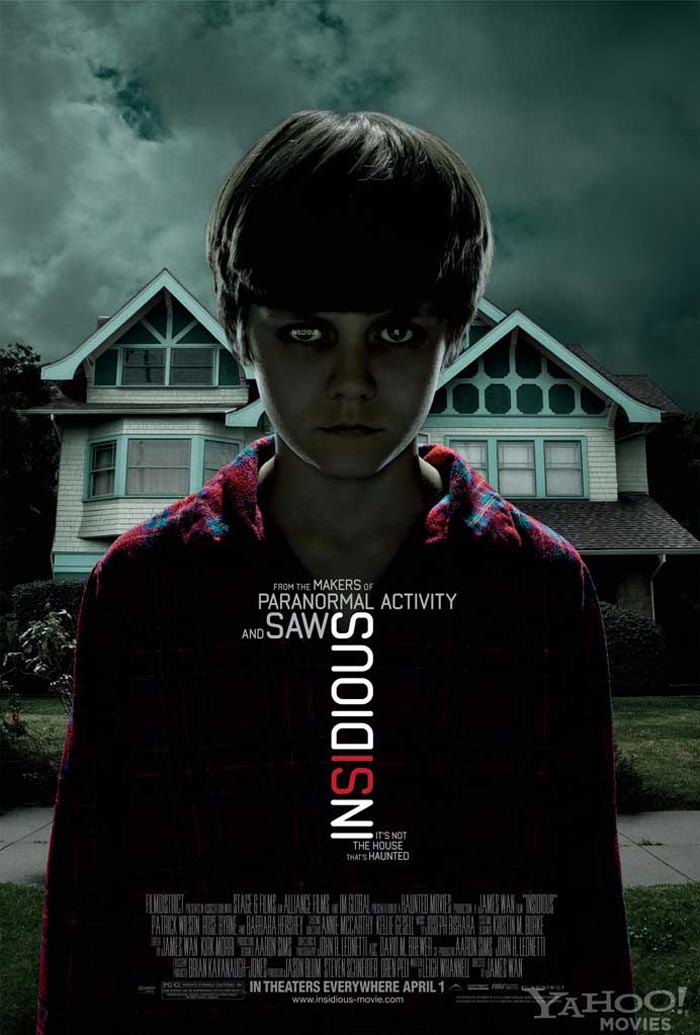
One Minute Review - Insidious

James Wan is probably one of the most talented directors who has never made a single good movie. And for the fourth time in a row (which has also included the original Saw film, the remarkably awful Dead Silence and Death Sentence) has teamed up with writing partner Leigh Wannell to create another sleek and effective dud.

The film opens with a creepy and brilliant prologue that promises spooky things going bump in the night and ends with a devious title card that promises evil but ultimately delivers cottage cheese.

Wan, as per usual, employs elaborate shots, knowing that there is more suspense and mystery in tracking than cutting, masterfully decorating his way through a story that feels a little like it is being made up as it goes along.

Things begin moving and appearing after a young son goes into a coma that, medically speaking, isn't really a coma; ghost hunters are employed; they explain strange phenomena that in turn explains a lot about what is really happening but not much at all of what its overall purpose is.

It's nice that the film has the common sense to feel retro in it's use of shadows and mood over gore, but just like a lot of those old haunted house movies, it eventually throws logic to the wind in an effort to tell a story and the more it tries to explain, the deeper it digs itself into ridiculousness.

Friday, December 31, 2010

One Minute Review (Maybe More like FIve Minutes) - The Blind Side

The Blind Side is the damnedest shame: a movie you so desperately want to like but one that ruins any chance at good faith around almost every corner. It's a film about serious issues and a powerful story that gets buried in golly-gosh-gee-shucks bubblegum sentimentality. If it didn't have so much white guilt it may have passed as a Tyler Perry vehicle.

The film is, of course, well made and well acted (although certainly not to any degree of justified awards recognition) and yet it's always either too lazy or far too simple-minded to get to the real heart of the story. This isn't so much the story of a black man who is given an amazing chance; it's the story of the white family who gives it to him. It's sad that, at what was then the beginning of 2010, Hollywood still can't tell a deeply felt, intelligent black story without the assistance of a white character to push things along.

Let's put it in context: would this film have been so easily made and widely distributed if it's hero Michael Oher was taken in by a black family? Would anyone care about the story if he was a white man in the same circumstances? The film never quite establishes (maybe it never quite figures out) whether we should cheer on Michael's success as a football player or pat the Touhy family on the back for doing such a good job by letting this man into their life. There's a scene in which Leigh Anne (Sandra Bullock) shows Michael to his new bedroom and he says he's never had one before. His own bedroom, she asks? "A bed" is his response. Then the film sneaks in one extra shot as Leigh Anne goes into her room and sits down for a brief second to contemplate this. The scene becomes less about the inherent sadness of this statement and more about how wonderful this woman is for giving this man a place to stay.

But what would happen, realistically, if Michael, not an idiot, but none too good at school when he is taken in, had sparked romance with the Touhy's teenage daughter Collins? Would they have allowed a romance to blossom? Would they have given their daughter away willing for marriage to this large black man? One suspects that the simplified, Leave it to Beaver, rich white existence that the family leads isn't as simple as this film plays it out as (is it ever?). George Orwell, as the legend goes, may have ridden the train car with the lowly proletariat, but drink of their water bottle he would not.

But now I've gotten out of context and diverted away from the fact that, outside of any social reservations, The Blind Side just isn't any good as serious drama. Like it's hero it's too wide-eyed and cutesy, like a love sick puppy, to ever offer up the serious payoffs that such material sound naturally gravitate towards. When Michael plays his first football game the team starts off by getting pounded by their rivals. When Michael finally comes to he drives his mouthy white opponent all the way to the end of the field and pushes him over the barricade. Where was he going asks the coach. "To the Bus," Michael replies. "That guy had to go." They both share a big smile. Aho ho, what a card. God bless white southern affluence.

And then there's the son, SJ, played by Jae Head, a kid too precious for his own good, who is blond, has a face full of freckles, crooked kid teeth and can call upon funny faces whenever the script requires it. After a serious car accident involving Michael and the kid, Leigh Anne rushes to the scene, finds Michael on the curb, head clutched in regret. She spots the stretcher and sees blood stains on the kid's clothes until the camera shows SJ looking up and joking about whether the blood stains will come out of his clothes. Good thing too, director John Lee Hancock almost let a serious emotion creep into the film.

And then it ends with a voice-over from Sandra Bullock who tells of a newspaper report of a black kid who was killed on his 21st birthday due to gang violence. All the papers focused on how good an athlete he was and how much potential he would have had if he had just gotten out. "That could have been anyone," says Bullock. "Even my son Michael." Yes it could have. Unfortunately not every black kid in the South has a rich white family to take them in and pay for all their dreams to come true. And I'd bet my last dollar that we'll never get a movie about that other kid.

Monday, October 4, 2010

One Minutes Review: Paranormal Activity


At this point Paranormal Activity is not so much a film as a cultural artifact. Somehow into the critical mix comes the knowledge that this isn't just a horror film, but an artifact that was made for next to nothing and went on to not only make hundreds of millions but also beat all the big money makers at the box office, while in limited release no less. Forget whether it's good or not, $100,000,000 doesn't lie. Truth is, when we strip it all back down to basics, the movie is only okay.

It begins with a brilliant and unquestionably scary premise. A girl feels as though she is being followed by a paranormal presence, which has been in and out of her life since age 8. Her boyfriend, who she lives with, buys a video camera in order to hopefully capture something on tape so they can get a better understanding of it. In all the extensive research he does on the paranormal he certainly must have come across some numbers to suggest that the likelihood of catching the paranormal on tape exists somewhere in the one percentile, but no matter. They call up a psychic who specializes in ghosts and informs them that he can't help. His speciality is the dead but what he senses is a demon which, he helpfully explains, is not human but rather some evil force that follows people around just to mess with them. And so the nights go. The occurrences start out mild: footsteps in the hallway, doors moving slightly to and fro, lights flicking on and off, Katie (the girl) getting out of bed and standing over Micah (her boyfriend) for hours without explanation.  

The psychic gives the couple the name of a demonologist to help them but Micah refuses the aid of the new doctor in one of the film's sly jabs at human nature: Micah's alpha male persona gets the best of him as he casts himself in the role of protector. Ain't no ghost going to mess with his girl. But the hauntings get worse: pictures are broken, loud noises cry out from the dark, footprints appear on the floor and Katie is dragged out of bed by an invisible force.

All of this is fine and dandy and by the time the hour and a half running time grinds to a halt, completely tiring and redundant. The majority of the hauntings occur in dark blue huges as the stationary camera films the couple's dark bedroom, a convenient clock in the bottom corner conveying the time. The setting is so repetitious that it ultimately negates the purpose. As soon as the lights go out and that blue eye-level shot appears we know that, sometime between 2:00am and 4:00am something spooky is going to go down and it's only a matter of time before writer/director Oren Peli stretches his prospects too thin. There's only so many times footsteps, flicked lights and absent-minded wanderings in the dark retain their power before enough is enough, leading up to a "shocking" ending which is, considering, about as predictable as it is unbelievable.

As a cultural artifact, Paranormal Activity is fascinating. As a horror film, it's passable for a little while.

Wednesday, August 18, 2010

One Minute Review: Black Dynamite

The problem with Black Dynamite is that it doesn't quite know whether it is a spoof or an homage and so it fails at both. How couldn't it? After all, as an homage it comes up short because what made Blaxpoltation so popular in the first place is that it had no point of reference other than itself. It didn't pay tribute to anything, wasn't inspired by anything and therefore played by it's own rules. As tribute, Black Dynamite has knowledge as it's enemy. It knows what Blaxplotation became, what it stood for, how it worked and so on. In this case, knowledge certainly isn't power. As a spoof it doesn't work because Blaxplotation was so off the wall that it, in many cases, played like it's own spoof. Black Dynamite is thus best when it is playing it perfectly straight because it combines the best of both spoof and tribute and manages to feel, in spite of itself, like an actual movie and can be quite funny. Here's a perfect example:
The film begins failing when it goes into full on Airplane style spoof mode in which it tries too hard and achieves too little. If nothing more though, Black Dynamite acts as an amusing reminder of why we should go back and rediscover all those bBaxplotion classics once again.

Friday, August 6, 2010

One Minute Review: Whiteout


Whiteout is a perfectly serviceable thriller and that's exactly it's problem. It's as well made as it's genre requires and acted to the same degree of competence, but it's about as good as the last time you saw it, and the time before that, and the time before that, and nearly every time you've seen it for the last 20 years or so. Whiteout is strictly by-the-book. It does what it needs to and doesn't try a whole lot harder. The story is the same as every other trapped-in-a-desolate-location/mad-slasher-on-the-lose film there has ever been and the conventions pop up like clockwork. There is however one kind of ingenious sequence towards the end. The whiteouts are so bad at the Arctic post where Kate Beckinsale is stationed that to get around from building to building the crew need to attach carabiners to ropes that are tied up around the base. This leads to an exciting climactic chase outside between the killer and the good guys, who cannot see each other outside of six inches from their face. But even this is problematic as all of the characters, bundled up in their snow gear, all look more or less the same. That seems to be what everything about this film comes down to.

Thursday, July 29, 2010

One Minutes Review: Sorority Row

Sorority Row is a real howler. In the third act, after it is believed that one of their sorority sister's who was killed in the midst of a nasty prank has come back from the dead to pick the remaining girls off one by one, the house's head mistress (Carrie Fischer) shows up unexpectedly with a shotgun to find the house in ruins after it is terrorized by the cloaked murdered. One of the girls accidentally lets it slip that they were responsible for the death of their missing sister. Instead of being baffled, shocked, taken aback, disgusted, anything that a normal person would do when faced with such information, the mistress racks the barrel and declares that whoever he/she/it is, it's about to get two to the face. Then, when but a few survivors remain and the killer's identity is revealed, one of the still living girls bashes the killer over the head with an inanimate object and runs away before checking if they are dead not once, but twice in the span of minutes. Shouldn't every horror movie character know by now that unless you physically see to the death of a demented killer, giving them a good whack or two usually doesn't solve much? It's been quite some time since a film was as heedlessly careless with it's audience's intelligence as Sorority Row is. Not that horror movies have never been dumb or anything, but ever since Hollywood started remaking every Japanese horror movie in sight or got all involved with movies about torture, they've been relatively straightforward, ugly and humourless. How rare it is to see one so lazily phoned in? Finally we get another horror film that no one asked for, that had no chance of being seen by anyone but horror fans and that couldn't care less that it's about as stupid as anything out there. It's nice to see that, in these economic times, Hollywood still has it in itself to throw money away for ol' times sake. That's it. The girls are stupid and not overly attractive. They are also vain, shallow and unlikable. Think of Sex and the City as a slasher movie. And they also go through all the old standbys of running up the stairs when they should be running out the front door. Oh ya and when they go back to the mine shaft that they dumped the murdered girl's body down they find the dude there who was the one who actually killed her because, of course, he's probably been waiting there all year since for the moment when they would return. That makes sense.

Monday, July 19, 2010

One Minutes Review: The Tracey Fragments (2 out of 5)

Bruce McDonald's The Tracey Fragments is not a film, it's a digital media experiment. The problem with experiments though is that sometimes they push so hard and so far that all they end up proving is that they are possible. That's kind of the approach on display here. The film doesn't really have a story other than that the main character Tracey (Ellen Page) is a depressed 16-year old from a dysfunctional family who has been disowned after her younger brother, who thinks he is a dog, has disappeared. We don't get to know much about the characters except what Tracey tells us. "I'm no different than any other normal teenage girl who hates herself," or "You heard the story about the retarded couple who had a kid? That was me." McDonald's approach to this material, which would be typical angsty teen indie melodrama otherwise, is to constantly split the screen up into fragments. At any given moment we are subjected to anywhere from 4 to 12 different images parading across the screen at one time. Sometimes they are adjacent to one another and sometimes within one another; sometimes within the same scene from different angles and sometimes showing us something completely different. The technique allows us to understand Tracey on more of a psychological level than on a traditional story level but it seems as though McDonald isn't using this visual technique for any better reason than to show us that he can. Conversations with Other Women is a great underrated film that used a split screen in order to add another layer of depth and intelligence to a story that would have been otherwise typical melodrama but here, despite some scenes of power and heartbreak, McDonald's hand seems to be ultimately closing on thin air.

Thursday, June 24, 2010

One Minute Review- The Wiz

There's a musical sequence to Brand New Day in The Wiz (1974) that is so perfect it's a shame the movie isn't better as a whole. It's one of those perfect movie musical moments: the music sores, raising the choreography from ballet to a kind of grace cut off from gravity, cut to the rhythm of the music, happening on a set built from the mind of a visionary. It may be one of the cinema's great musical sequences. And yet it comes late in a film of extreme ups and downs. The Wiz, based on a Broadway musical, inspired by The Wonderful Wizard of Oz by L. Frank Baum, was allegedly the most expensive musical of it's time and certainly one of the most expensive productions ever filmed in New York City. The film was directed by Sidney Lumet, a master filmmaker if there ever was one, and there are scenes of such utter genius in which it appears as if Lumet knows exactly what he is doing. And yet, which such money at stake, the inevitable seems to eat up any potential the film had of succeeding as a whole. It's more a collection of pretty set pieces and snazzy location shooting than any sort of complete narrative. From one moment to the next the film is alive, the songs magical, the experience uplifting and yet there is nothing propelling the story forward. We know the tale from the Judy Garland Wizard of Oz film but it's at the service of art directors, set designers, cinematographers and choreographers. There's too many hands to fit in this pot. Maybe one of the film's most central problems was to set the story in 1974 New York City. By having Dorothy and co. run through subways stations, amusement parks and by building Emerald City in a lot behind the Twin Towers the film is its own distraction and lacks the fantasy element of exploring a new world. In a sense, by those standards, the original film was more believable as a complete immersion into fantasy. The Wiz is, by comparison, a slide show with movement. And yet the film has so much of value. Lumet captures the song and dance as well as any director trained in musicals could have, Diana Ross' voice soars as Dorothy and Michael Jackson steals the show; so gentle and tender buried amid his make-up as Scarcrow. I guess that's the danger of letting money make the artistic choices: The Wiz is magical when taken as a collection of moments, but it's not much of anything else.

Wednesday, June 16, 2010

One Minute Review- I Hope They Serve Beer in Hell

At the beginning of I Hope They Serve Beer in Hell there is a disclaimer informing that this film is based on a true story...and then adds, "Unfortunately." It's hard to say if the film is trying to be ironic or if it actually knows just what a pathetic display of human waste it is about to wallow in, but I'm thinking it's leaning towards the former. Not least because the film was written by inexplicable Internet sensation Tucker Max who wrote the book that it is based on, which chronicled his own shallow exploits into sex, booze, feces, what have you. On an artistic level the film's first problem is that it doesn't know who it wants to be about. It can't be about Max himself because he's essentially a walking human tragedy in clown's clothing. So it gives him two friends, one who thinks he is being taken to his own bachelor party weekend but is actually being dragged along so Max can hopefully add to his collection of deformed sex experiments. He's had a deaf girl under his belt, now he wants a midget. The other guy is too smart for his own good, would rather play Xbox than breathe, talks in a sickening, condescending way that no one but he could ever mistake as clever and hates women. His best line at the bar is to tell a girl that if she doesn't get away from him he will gut her. That he hooks up with a stripper who disgusts him but matches his insults is, I guess, what passes for sweetness in Max's world. Until this point the film is just a stupid, shallow unfunny comedy about some uniformly unlikable guys trying to live an Animal House fantasy life. Then the film slips into complete degradation as Tucker and a girl he picked up at a bar have a serious case of the poo-poos after his beer is spiked. I won't describe what follows other than to say that when I woke up today I was prepared to see any number of different things. I man spilling his liquid excrement atop a hotel lobby floor was not one of then. Tucker Max, I suspect, is the kind of guy who gets off simply by having a medium for him to write about himself, which is his only subject. At the top of his website he introduces himself as an a**hole and I don't doubt for one second that he is. However, as played by Matt Czuchry he's nothing short of a despicable slimeball who no self-respecting woman would ever be caught dead with.

Monday, June 7, 2010

One Minute Review- Legend

You ever get the sensation of too much tranquillity? Like being in the woods on a beautiful day with butterflies fluttering and birds chirping and other miscellaneous things floating about and it just takes it out of you? It reminds me of a famous Richard Pryor quote, "There's something about the woods that just makes you want to...s**t." Ridley Scott's Legend from 1985 suffers from tranquillity overload. It has golden hues, unicorns galloping in slow motion, fairy's glowing in the sky, pedals falling in slow motion, water glistening, Mia Sara, and enough soft focus to make the lightest of eyelids hang heavy.


That's the light side of the story. As the opening credits reveal, the universe exists due to a balance between light and darkness, this balance creating legends. Think about this though, if light came along and banished darkness into an underground abyss, how is that balance? Isn't that light triumphing over darkness and casting it aside? If there were balance wouldn't the two get along and work towards achieving the same desired ends? Forget it. The darkness is ruled, no kidding, by The Lord of Darkness (Tim Curry, under so much make-up that it's of little consequence whether it's actually him or anyone else). The darkness is made up of hammers thundering against metal, sparks flying and fire bursting out in every direction (which is kind of the opposite of darkness if you think about it, but no matter). The story involves some such business about how unicorns keep the world in light and Lord wanting to kill the last two.

This is all undermined by the fact that the hero (Tom Cruise) is an afterthought behind Scott's relentless visual muck. Legend is a film comprised of nothing more than thin air. There is not one meaningful thing that happens in it; not one speck of continuity and not one character who is remembered long enough throughout the duration of the film to amount to anything meaningful.

There is though, an interesting Celebrity Connection:

Could that fairy really be Taylor Swift in disguise?

Wednesday, April 7, 2010

One Minute Review- Next Day Air

Next Day Air is the debut feature film from a music video director named Benny Boom. No joke. Generally guys with names like Benny Boom don't make boring movies and indeed Next Day Air is a hyper-kintisized version on that old fail safe genre of comedies parading around disguised as hard boiled thrillers. Someone has been reading up on their Elmore Leonard. It's a tried and true formula, and to be sure Next Day Air brings nothing new to it but hey, if it ain't broke, ya know? So what we are greeted to is a large cast of eclectic characters who all go about different business but will, in one way or another, connect by the end of the film. There's the ever stoned delivery guy who delivers a package full of high grade coke, not to the proper door but to that of the incompetent bank robbers who stole the security tapes instead of the loot ("get the safe" is mistaken for "get the tapes," you see) and need to make a getaway on foot after they discover that they locked the getaway car. Thus, the robbers want to sell the inheritance, the Mexicans who it belongs to want it back and the delivery guy just wants more weed. Although this whole enterprise is not plotted as tightly as say Pulp Fiction or Jackie Brown, it's in the same artistic vein as early Guy Ritchie capers, and all of the actors seem to have a good time with the material, especially the surprisingly restrained Mike Epps who steals some of the film's best lines. Minor, but not bad for a first timer.

Thursday, April 1, 2010

One Minute Review: It Might Get Loud

I have no idea how Fellini filmed the opening sequence of 8 1/2 where Guido flies above the beach, being tethered to Earth by no more than a string around his ankle that is being held by his producers. Sure, I could read a book on Fellini or look it up somewhere online, but I don't want to know because the more I know about it the more it feels like filmmaking and the less like magic. That's the feeling I got while watching It Might Get Loud, which strikes me as the kind of documentary that may be enjoyed more by people who care less about filmmaking and more about music. The film follows around three big name guitarists (Jimmy Page, Jack White and The Edge) as they recount how they started on the guitar, how they found their sound, what their first guitar was, their musical history and so on. Sometimes these memories are conveyed on their own and sometimes in the middle of a three-way jam session between each of the men. Guitar players will find the film interesting in that it shows their heroes breaking down their craft, but one is ultimately left wondering at the end just what the film was trying to achieve as it strikes an uneasy balance between deciding if it should be about the guitar itself of the men who have made their names playing it. In the end it kind of feels like something you'd watch on VH1 on a bored afternoon when you couldn't muster the ambition to do anything else. Note- In case the opening comment wasn't clear enough: I cannot play the guitar but am thoroughly fascinated by those who can do so well.

Wednesday, March 24, 2010

One Minute Review: Dead Snow

I've always wondered whether, if a bad movie knows it bad, that somehow negates it's badness? After all, a stinker by any other name...as Shakespeare one said. If we were to take Dead Snow as a measure of this question, the answer would be no, badness does not compensate for badness. Even worse, this low budget Norwegian gore-fest is also painfully self-reflexive. It knows it's a movie and wants you to know it too. "How many movies can you think of where a bunch of teenagers go to a cabin in the woods without cell phones?" Asks one of the characters, which almost leads to a debate about whether or not Evil Dead 2 is actually a sequel to or rather just a remake of Evil Dead. Then, during a game of Twister someone asks why they even bother to play such a game. "Because Hollywood has taught us it's the best game ever," is the reply. I can't remember the last, or even the first time I've seen a Hollywood film pine over the brilliance of Twister. And then the gore starts as a group of hapless medical students are attacked by zombie cannibal Nazis after being warned of the evil that lurks near them by an ominous old man who looks kind of like Harvey Keitel and is apparently only out in the woods to tell these kids how dangerous it is to be out in the woods. Based on that description you should know if this movie is for you. If not, it's basically the same ol' thing.

Monday, March 22, 2010

One Minute Review: Adoration


Atom Egoyan is one of Canada's premier directors and although Adoration does not present as tightly wound a narrative as one usually expects, it is still nonetheless a strange, powerful, twisted meditation on the director's personal fascinations. The film once again takes up Egoyan's preferred narrative structure of starting in close-up and gradually pulling back, revealing how a group of seemingly random people and events are actually all intertwined. This is also the first film where Egoyan doesn't seem to be hopelessly pining for his Armenian homeland and instead presents a more gentle and subtle reflection on religion and technology and how both work together and in opposition to create new pasts and presents out of thin air, to the point where we become consumed with them and they begin controlling our lives. I'm not sure all of these opposing elements fit together as well as Egoyan would like them to, but this is still a mature and though-provoking film.