Over the weekend the Siskel to my Ebert Vancetastic at The Audient left me a comment asking how I had decided to ditch my star ratings just as he is starting to implement his own. I do have an answer for him but unfortunately it won't be of much use to him, or anyone else, from a practical standpoint, but let me explain my rationing in full.
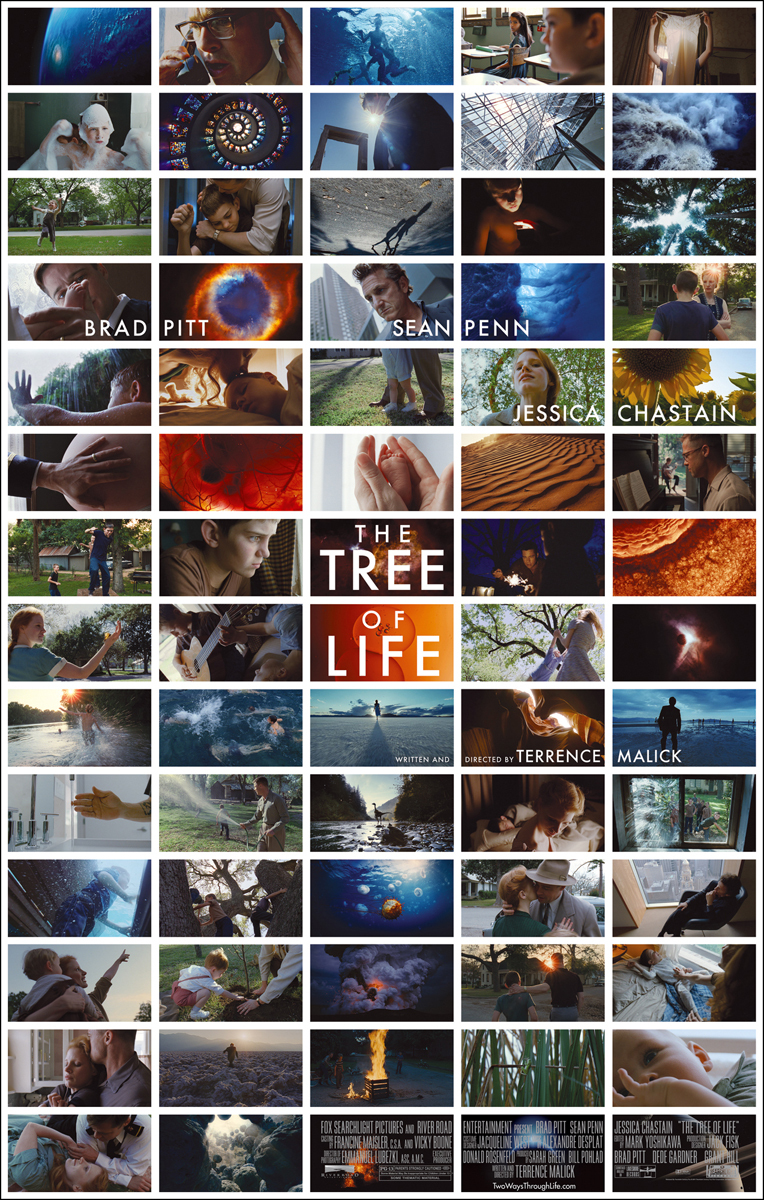
The truth is, my view of the world changed (expanded may be a better term) and so the way I related to it also needed to change. The best why to explain how it changed is to explain what it changed to and the best example to use, in remembering that this is a film blog, is Terence Malick's masterpiece Tree of Life.
If you trace the world back to the dawn of creation (let's leave God out of this debate just for argument's sake) it came into being as a physical thing. Who knows exactly how or why it happened but low and behold we have a huge physical mass that, eventually grew to be able to sustain life.
And so, life happened. But, the first man/creature/plant/whatever didn't have any knowledge to begin. This thing was among the Earth's new babies and so it was up to them to learn. From learning springs knowledge and from knowledge springs evolution, and from evolution springs conventions and ways of thinking/feeling/doing which we turn into tribes/cities/societies/any sort of governing body that helps us guide our lives based on a set of agreed upon theories/principals/modes of belief/whatever. That's why you can trace all knowledge back to a select few original things (5, 20, 100, pick a number). Everything since has just been different examples of these core human discoveries.
So that's, in my mind, how evolution worked. I don't know what a stove is, I put my hand on a hot burner, it hurts, I now know that heat will burn. Cooking requires heat, so don't put my hand on the stove top when it is hot. Every time I think of putting my hand there again I remember that time I was hurt by doing so. Now I will be cautious around any different thing that is hot. It all traces back to one instance.
But not only do I have knowledge, I can also share it. I can tell a friend, cousin, sibling, stranger or child this because I've already done my homework. Learn from my knowledge not my experience getting there. However, my example is not absolute. Who's to say, after all, that someone else can't do the same thing and experience no pain? I make my knowledge public but the experience it is based on is mine alone. (ed- Obvioulsy the person who doesn't feel heat would still get hurt, but let's not get off course with knitpicking).
So there's the problem. Knowledge is a human concept and being so it is flawed and open to interpretation. We don't trust one another, we lie, imagine, dream, make things up. Every one's minds are different, bodies are different and so on down the line. No two snowflakes are the same. If I say a shirt is red and someone else says it is pink then how are we to really know what the true colour of this object is in the real physical world that exists outside of our bodies, which are the only connections we have to it? My only knowledge of this colour is that which my brain deciphers through my eyes, all of which, because they are human, have a margin for error and are programmed differently than every other set of human eyes on this planet. And so, as Socrates said it, "All I know is that I know nothing."
That's all I know too. That's all anyone knows really if we trace life back to the very beginning. To go back to the stove: I didn't know something, I had an experience, now I think I know something and can do with that information as I please. I can judge all people who touch stoves as stupid and unsophisticated because they don't have my knowledge and I am certainly not stupid and/or unsophisticated; I can tell everyone it is a sin to touch stoves or I can keep it to myself and take pleasure in seeing other people discover the hard way as I did. Anything. Because knowledge is man made the key to it is that it only becomes knowledge worth knowing if a large body of people think about it and agree. The Earth is round, water is wet, the sun is hot, stoves burn hands etc. Sure, I have no real gain in arguing.
So all knowledge, at the end of all of this, is the extension of the experiences of the few forms of life that existed at the very beginning. What was it? Who knows? In Tree of Life it's dinosaurs. In 2001: A Space Odyssey it's apes. What it is isn't what's most important.
And so there we see it, in Tree of Life: a Dinosaur can kill another of its own and then decides to show what we now recognize as compassion instead. But it's not compassion. Compassion is 10 letters we have put together as a way of easily expressing what this dinosaur at the beginning of the world has experienced. And from the first time comes the second, the third, the fourth and so on for the rest of time until we achieve recognition of the thing without so much as a second thought.
From this one act of pity, the first of it's kind as far as we need to be concerned, comes something that we now base entire societies on. Did you're boss let you take the day off without hassle when you were sick or force you to work in your misery? Thank that dinosaur if he did. The concept dates back to the beginning. Plug in any example you want as a way to express it, the concept always stays the same.
Similarly, in 2001, from an ape realizing that a bone can first be used as a tool and then a weapon and then so on at the dawn of time we evolve to a time of huge, complex, vast space stations that are populated with technology that is unthinkably sophisticated and can, as everything before it, be both tool and weapon. Life being but a reoccurring instance of these core things just in different forms, which change as people pass their knowledge on down the line from generation to generation. People, after all, need different examples before they find one that clicks. That is, to me, the definition of clarity (being able to peel back the examples on the way to the core).
That's the groundwork laid, which Tree of Life takes roughly 20 of what can only be considered some of the most beautiful moments ever put on film, to establish. Present day and a boy is trying to decide if he should live like his sheppardly mother or his stern father. That's where this quest starts for everyone in their own unique way: at the level of family until it slowly extends outwards on the journey to the end where it can all make sense in one final and infinite way. What does one hold on to? What does one dismiss? Do I touch the stove or just take dad's word for it? Life, having evolved so far away from original experience and being so full of examples of knowledge that can either help or hinder, is big, messy and confusing.
Some people believe in gods to make sense of what happens in life. Some believe in science to unlock the mysteries on the universe. Some believe in the revelation of some true paradise after death. And some believe in knitting. Anything to give some purpose and direction to this jagged mess of possible meaninglessness. They are all wrong because none of them will ever know completely for a fact that any of these things are true. They are also all right for the exact same reason. The coin, after all, without exception, always has two sides.
The conclusion then that Tree of Life leads to (along with Citizen Kane as well if you need another reference point) speaks to me deeply and touches me profoundly. This is not because it houses some universal truth about life or nature or religion or anything, but because it places the entire history of the creation of the world within the story of one man and his family and ends in a place that, for symbolic purposes I guess is Heaven, but to my mind doesn't need to be that symbolic. It's the only place in life when everything makes sense. At the end. The picture is complete. At the end of Mike Lippert no new knowledge will enter his head or influence him to change who he is, how he behaves, how he thinks and how he relates to the world. The story of Mike Lippert has been written.
Which is why Tree of Life and Citizen Kane end where they do: in the one place, at the end, where every object or person that has ever influenced the lives of their protagonists can be found. Just as we can trace all knowledge back to it's origins, when we come to the end, the only true way of knowing who a person really was is to trace all the objects in their lives back to the very beginning of it.
And that is why I believe there is no absolute knowledge, no right and wrong, no nothing outside of self analysis. We make of it what we will based on what we encounter along the road. If there's a God or aliens out there or whatever really isn't for me to know right now but I'm sure to always keep the possibilities close by. Everything, thus, is only as it appears to the individual. Everyone struggles so hard to define themselves, to live the right way, do the right thing and be the right person to the right people. It's exhausting and drives some to insanity, paranoia, obsession, you name it. There will always be comfort in others, but everyone, no matter who they are, what they do or where they come from, are in exactly the same boat as us: making it up as we go along. Some have an easier time admitting it than others.
It's only if we put all of the knowledge in the world together in one place all at once that we would be able to establish some sort of clear picture of what it all means. It's the same for the individual. So now Socrates needs updating: All I know are the things I know even if I don't always know what they mean because I really only know nothing when it comes down to it. And so life goes.
So why drop the ratings? Because, who cares about them? I love discovering myself though film, not awarding star ratings. I watch movies because every once in a while you'll come upon a Tree of Life or a Citizen Kane or a 2001 A Space Odyssey which play before you and tell you everything you've ever thought was true or ever wanted to hear before.
And even when I just watch the movies to be entertained, who am I to judge a work created by people I don't know, under circumstances I don't understand unless the people involved want to make that knowledge public?
In the grand scheme of life then it seems like a worthless pursuit to try to reduce a film into however many symbols out of five. I respect film too much to do that to it. It's taught me so much about my own life and informed my thinking and actions so much over the years. It's the least I can do for it in return.
But hey, that's just me.