Showing posts with label Adam Shankman. Show all posts

Thursday, April 4, 2013

Rock of Ages


Rock of Ages is the story of a sweet young blond girl (Julilanne Hough) who arrives in the big city with dreams of one day becoming a star only to end up paying the rent through stripping.


Wait, I think I've already seen this one...


She quickly gets a waitress job at a bar owned by Alec Baldwin, whose appearance right from the outset makes me wonder what he spent the cheque on.
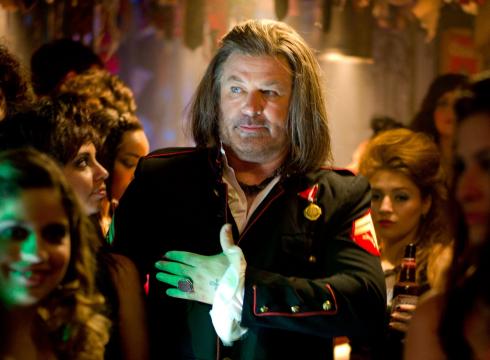

At least, being an an actor skilled enough to deliver the dialogue of David Mamet on stage, he has the good sense to phone this one in, unlike another recent non-singing actor taking a crack at the musical genre, not to name any names:


He's on the verge of losing his bar and needs a way to make money quick. Wait, I think I've seen this one too:


Thankfully he has his trusted sidekick, played by Russell Brand, who, I shit you not, declare they are queer for each other during a rendition of I Can't Fight This Feeling:


Baldwin's plan is to pack the house with the appearance of rock god Stacey Jaxx (Tom Cruise) who he gave his first gig to way back in the day.

Jaxx is managed by this:


Yes, that is indeed Paul Giamatti...

Jaxx however, underneath it all, is a boozey hack and is told so by Malin Akerman, who then rocks his world PG-13 style to I Want to Know What Love Is. I'm not sure you'd consider this figuring it out or not?


This is at least the second time in history that a Tom Cruise character has had bullshit called on him by a female interviewer:


So the little blond falls for the handsome male bartender who also dreams of making it big and finally does when he's given a last minute shot. The taste of fame quickly lures him away, leaving miss Hough to crash up against walls while belting 80s hair-metals cheeseball songs from the very centre of her (heavily automtuned) soul:


I wonder if that's the way Seacrest used to like her?


Anyway, Jaxx packs the house for a thoroughly gayed-up rendition of Def Leppard's Pour Some Sugar on Me, during which he jerks a huge jizzlob out of a water bottle and onto the audience:

 
As these things go, the girl becomes a stripper, the manager robs the house leaving the club in trouble again, an ultra conservative advocate that someone should have had the good sense to cut from the script before Catherine Zeta Jones was cast, tries to end Jaxx's career, the hunk gets a gig in a boy band that makes him miserable and so on and so forth.
 
All the while the songs do nothing to advance the story in any real meaningful way.
 
Rock of Ages was constructed under the, what I would assume to be incredibly soft, hands of Adam Shankman,
 
 
A choreographer who also made the much better Hairspray musical a couple of years back. I'll give him this, from an aesthetic standpoint, these two films are shot, edited and choreographed better than most of the big budget Hollywood musical trash heaps of late.
 
But the story sucks, the songs have never been my personal cup of tea and all of the actors (save for Mary J. Blige) are all autotuned so heavily  that one wonders if they even needed to show up to the studio to record their parts.
 
Wait, I think I've seen that one before too...


Wednesday, May 26, 2010

My Favourite Musical Blog-A-Thon: Hairspray

To let up for a moment form the movies that made going to the movies suck and to get some of my own writing back on this site, I've decided to play along with an idea that Andrew came up with over at Encore's World of Film and TV where people pick their favourite musicals and write about them. Although my favourite musical is Rent, I'm sure many can agree that the movie version was, if not a total wash, missing something special that it has on the stage (and some major songs to boot) so I've decided to write about Hairspray instead. Enjoy and be sure to check out the other entries as they appear.
Some people live for the films of John Waters…Watch out for them! - Professor P. Tiessen Hairspray is an adaptation of a Broadway musical which was in turn inspired by a 1988 film by that contemptible cult auteur John Waters. With a steady supply of sexual taboos in the palm of his hand, Waters assaulted audiences with images of unspeakable perversions and human atrocities as if we should accept them as commonplace behavior; you’ll never be bored by a John Waters film but after having seen one you realize that boredom may have been the more decent alternative. Love it or hate it, it is what it is. However, in 1988 Waters stepped out from behind his X-Rated cocoon to make a quirky, campy piece of low-budget kitsch in the PG-13 realm (which he would only ever do once more in 1990 with Cry-Baby), about a chubby preteen girl trying to find her place in the early segregated 1960s, called Hairspray. Underneath all of Waters’ pompous flaunting of amateurism and crude social commentary, laid the man’s most personal, heartfelt film, and for a brief moment we understood John Waters as a human being and what it must have been like for him to grow up an outsider in 1960s Baltimore. To watch the original film now is to realize that it was, at its cinematic heart, a musical without a soundtrack. An exercise in excess and camp, just like a musical, Waters threw away the mechanics of conventional storytelling and made a film that threw its every ounce of attitude and corny pizzazz in our faces: mocking the beatniks, making pointed attacks at popular culture and the plastic reality it creates, and bearing a cast that read like sideshow attraction of talent, from an overweight transvestite to Sonny Bohno. A Broadway adaptation of Hairspray is then an ironic act of logistics. By trading in the camp and amateurism for vibrant dance sequences and uplifting 60s-inspired pop songs, director/choreographer Adam Shankman has turned in a better film than Waters probably ever knew he had to begin with. The original was the Coles Notes version; finally we are allowed to see the possibilities of the story in full bloom. The lives of Tracy Turnblad and Penny Pingleton revolve around that moment when they can race home from school to watch the Corny Collins Show, a dance variety program in which a bunch of popular, well groomed teenagers perform choreography overtop of popular songs while the Dick Clark-like Corny mediates the events. The stars of the show are Link and Amber von Tussle, whose mom Velma (the deviously sexy Michelle Phieffer) manages the local television station in Baltimore. With dreams the size of her waistline, Tracy skips school one day with Penny after Corny announces that the show will be looking for new talent and all teenagers are welcome to come out and audition. Although encouraged by her father (Christopher Walken doing a wonderful variation of Christopher Walken), the idea is frowned upon by Tracey’s overweight mother who is played by the scene stealing John Travolta in a fat suit (not so strange considering the role was originally written for John Waters’ cross-dressing star Divine). There is social commentary brooding in the sidelines as well as we learn that the Baltimore TV station is segregated. Thus black people are not allowed to be seen mingling with whites on screen and are allotted airtime once a month when the Corny Collins Show (apparently the only thing on in Baltimore) hosts “Negro Day.” After leaving from her audition humiliated, through a logical progression, Tracy not only makes it on the show, but also becomes a huge hit (no pun intended), leading to speculation that she could steal the title of Little Miss Hairspray (also hosted by Corny Collins) from Amber who is beautiful but a terrible dancer. There is also a subplot about Tracy learning to stand up for what is right by being involved in a protest march for black equality. As a musical Hairspray is Grease for a generation who are not qualified enough to understand the potential power and pleasure of a classic Hollywood musical; remembering a time when musicals could be fun and adventurous and touch us in a certain special way that narrative films just couldn’t. By introducing a sweet young actress in Nicky Blonsky who is a ball of fire and energy, able to carry the entire film on her shoulders, by gathering a cast of eccentric talent, by staging stunning choreography around show stopping pop songs like “Good Morning Baltimore,” and by having a big star like John Travolta create a real character out of a role most actors would play as a gimmick, , Hairspray succeeds at being one of its summer's finest features. But it doesn’t stop there. By taking this story of a chubby girl chasing her dreams out of the John Waters universe and brushing aside inside jokes and obscure cultural references, the message is as simple and touching as ever: Never give up hope; dreams are not selective and anyone with the courage to reach for them has the tools to catch one. Tracy Turnblad is the hero of a moment in time worth getting nostalgic over. Remembering a time of innocence before revolution, a time when people had dreams and stood for something because of it, Hairspray constructs the perfect emotional tone for a wonderfully uplifting fable about how it was possible for a lovable fat girl with an eccentric upbringing in crummy Baltimore to reach for the stars, only to become the most popular girl in town. Times aren’t like that anymore; we’ve lost our innocence, trading it in for darkened cynicism and technological isolation. Thankfully every once in a while a film like Hairspray comes along to remind us that things weren’t always this way. Note: Although both original cast members Sonny Bohno and Divine are no longer living, one who looks close enough will see cameos from original Hairspray cast members Jerry Stiller and Ricki Lake. The truly keen will also spot John Waters himself, who appears and even gets a laugh in the opening scene at the lyric “And there’s the flasher next door.”