Showing posts with label Bradley Cooper. Show all posts

Wednesday, April 10, 2013

Limitless (2011)

A man runs into a former acquaintance who introduces him to something which will change his life and alter his perceptions. No, not David Fincher's The Game.


There are three immediate reasons that I can see as to why Limitless got made. They are, in about this order of importance:


And if you can recognize the first two without any subtitles under those pictures, you're about what the studio was hoping for. And with an $80 million North American gross against a $27 million budget, about what they got.

It must have been that because, quite frankly, the script is mostly shit. The concept surrounding a man who is given a not-yet-on-the-market drug that unlocks 100% of the brain's function is an interesting one, but, come on guys, I know I don't have an MBA or anything, but if a drug unlocks 100% of brain function, once everyone is on it, wouldn't that leave them, more or less, all on the same playing field again?


Nevermind.

Okay, so this is a movie about drug addiction? Oh no, I see, it's about the physically and mentally draining demands that corporate cultures place on people to succeed? Hold up a sec, Bradley Cooper wants to do a cliff dive.


Now I think I get it. It's about mentally conditioning your brain to not hold you back from achieving your...FIST FIGHT!


And so on...Jesus, someone put a lease on this puppy!


Seriously, where's Philip K. Dick when you need him?


Oh right...

So Bradley Cooper's Eddie Morra, speaking to us often in painfully bad voice-over, takes the drug and instantly it's as if his eyes are opened to the world. He goes from lowly struggling writer who has a deadline and not a single word to being able to detect algorithms on the stock markets so fast that he could probably make a million over night. It's never quite explained how the drug gives it's hero the super human strength to dive off cliffs or beat the shit out of a half dozen or so goons who want to jump him but, ya know, whatever...


Isn't Bradley Cooper dreamy?


Then his supplier is killed, he gets mixed in with a European gangster, and finds that once you come off the drug you crash, puke a lot and die. This leads to am unintentionally hilarious scene in which Eddie breaks into girlfriend Lindy (Abbie Cornish)'s office, collapses to the floor in what looks to be a near death panic begging for help and then, exactly one shot later, kicks back and chats her up a bit, looking not too bad all things considered. There's a stash of the drug that he hid at her place. She goes to get it for him. He waits, I shit you not, on the floor in her office.

Eddie's new found brain power attracts businessman Robert De Niro, who puts him to work gathering intel on his competitors in order to consult on a huge corporate merger. Is it a spoiler if I pose the hypothetical question of who you think the bad guy in all this could be?

The film was directed with some great style by Neil Berger who manages to visualize the drug trips in interesting ways and opens the film with the coolest walk through Google Maps Street View you've ever seen under the opening credits. See, look:


But that's the problem: this film is all exhibitionism. It's got comedy, drama, romance, action, and not a single fucking clue what it's suppose to be about or how any of this fits together.

I'm left reminded of the basic Shakespearian principal that, no matter how stylishly conceived, how technically proficient, and/or how well acted, a shitty script by any other name...ya know?

Monday, June 13, 2011

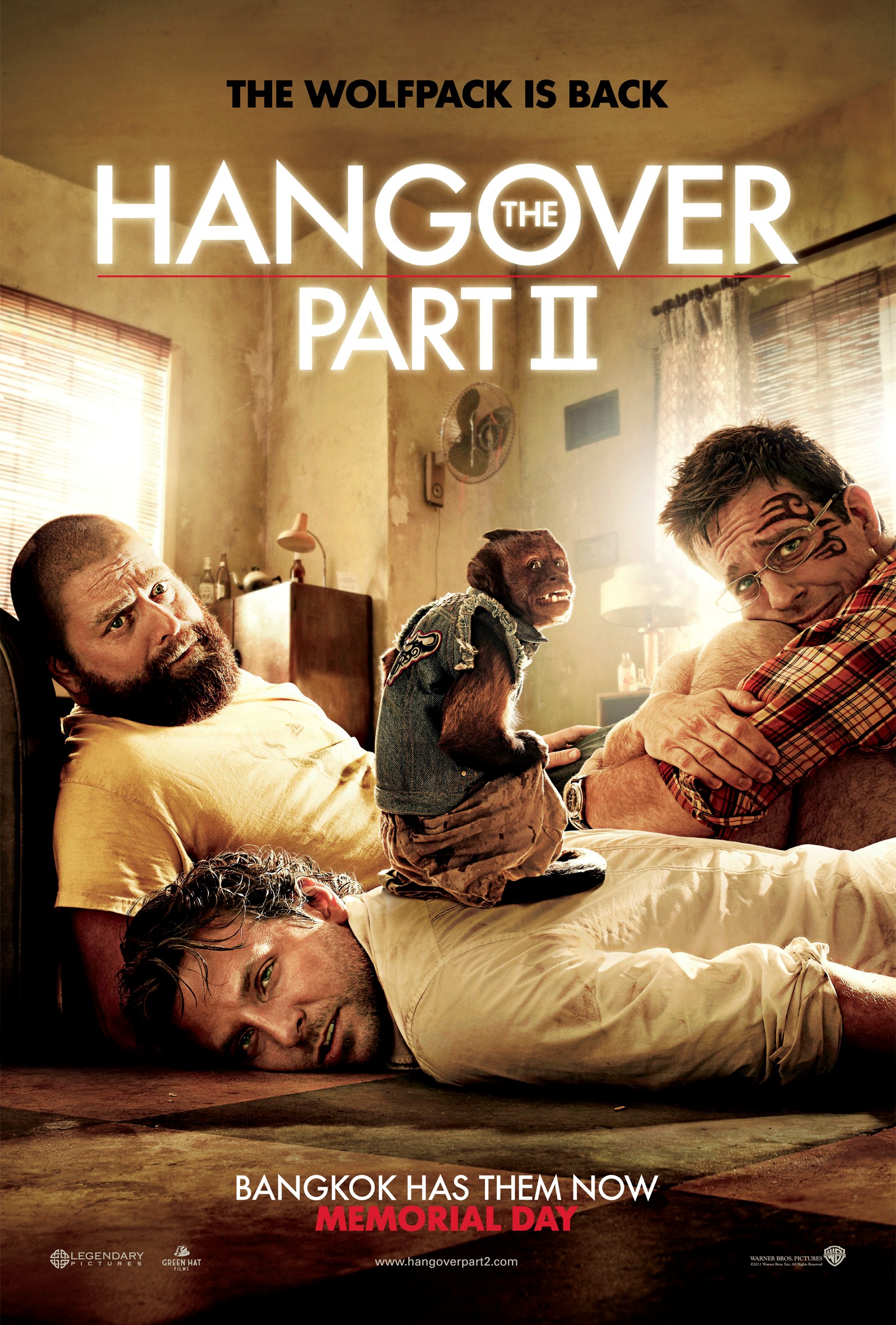
The Hangover Part 2


When a run ragged Bradley Cooper appeared in the first scene of The Hangover, in the middle of the desert on a cell phone telling someone on the other end how he had seriously F.U.’d it was one of the great comedy set-ups. He wasn’t kidding and, with giddy delight we were going to see just how. When Cooper appears in the first scene of the sequel to say he seriously F.U.’d again it feels like we’ve already been there and seen that. The premise is the same but the shock and intrigue is missing.

Not that director Todd Phillips and his team don’t try to keep the shocks coming but that’s just another one of the problems: most of what is memorable in The Hangover 2 is not how quick and hilarious it is, but just how far it is willing to push the boundaries of good taste for a laugh. But the laughs are few and far between, being undermined by the gross and absurd. It’s like Phillips forgot that the premise is the set-up not the punch line this time around.

What made the first film special above all else was that, although set in Las Vegas, it seemed to take place in a surreal parallel world in which a bunch of random objects came together and all fit in such a way that made perfect sense. It was darn near Kafkaesque. This time the boys find themselves in Bangkok and although everything makes sense again this time it’s not as inspired in it’s madcap schizophrenic way. By the time the film has been reduced to high speed chases away from Russian gangsters and crooked business men one gets the sense that we are looking at a film having fallen to the everything in the sequel needs to be the same but amplified school of thought.

This time out Stu (Ed Helms) is getting married in his fiancĂ©e's native Thailand. Phil (Bradley Cooper) and Doug (Justin Bartha) are invited as well as, after some pleading from Doug, Alan (Zach Galifianakas) who hasn’t stopped talking about Vegas and has pictures from that trip that probably shouldn’t have been published let alone be allowed to hang from his bedroom walls.

Also along is Stu’s brother-in-law to be, the 16 year old Teddy. The boys decide to have one drink on the beach the night before the wedding, thinking nothing could possibly happen. Then they wake up in a grungy hotel in Bangkok with a monkey, no sign of Teddy and Mr. Chow (Ken Jeong) the Asian gangster from the first film. Chow, knowing what happened to Teddy, is about to spill the beans before taking a hit of coke so big that it kills him. So they ditch the body and begin their search.

Their journey brings them into contact with a mute monk, a tattoo artist played by Nick Cassavettes which is surprisingly mild for a cameo role, a drug dealing monkey, and a club that Alan hilariously mistakes as a magic show.

Some of this is, for what it’s worth, quite funny. But it’s not enough. The movie, like the first one, pushes boundaries, doesn’t care who it is offending and will gleefully go anywhere it needs to for a laugh even at the expense of alienating just about everyone in the audience. I admired that quality the first time around as well and although Phillips has turned in a well made film, and the actors have all done their work, something just isn’t clicking. The magic of going on this journey and solving this mystery is gone this time around. The pieces are all in place but they don’t build a new enough puzzle.

In my review of the first film I said that the only way to ultimately rate a movie like this is by how much you laughed. Fair enough. I didn’t laugh nearly as much.

Wednesday, June 16, 2010

The A-Team

The best shot in The A-Team is the very first one. The camera flies over some barren Mexican landscape. The shot is smooth, clear, and most importantly, continuous, being allowed a duration of what feels like 5-10 seconds. What’s on screen hardly matters because it is being captured so well. This shot is an ideal one to call out in the argument for the importance of smooth, uninterrupted takes in action films. When the camera is tracking it’s best to allow it the freedom to move without interruption because a long take means movement, which is inherently kinetic, which is inherently exciting. Think about a roller coater ride. The reason they are so exciting is because they involve one unbroken stream of action in a single, controlled, straight forward direction. You understand what is coming with complete clarity and the movement makes it exciting. Imagine a roller coaster ride with jagged edges coming from every angle, meaning you can't see or know what is ahead of you? Sounds more sickening than exciting no? The A-Team is a film built on jagged edges. What is becoming one of the film's most quoted lines is one where A-Team mastermind Hannibal Smith (Liam Neeson) declares that overkill is underrated. He’s right; it can be, if it’s filmed right. The A-Team, despite a plot that is convoluted, hard to follow and not easy to care about, is not, to say the least, filmed right at all. There’s a helicopter chase sequence at the head in which schizoid pilot Murdock (District 9’s Sharlto Copley) not only spins his chopper 360 degrees around to avoid incoming fire but also avoids two heat seekers by flying the craft upwards until it’s on a 180 degree angle and then kills the engine, sending it into a free fall. It would be an amazing feat of ridiculousness, if you could see it happening. Instead director Joe Cranahan (Smockin’ Aces) and his editor kick it into overdrive and lose the entire focus of the stunts. Before Murdock can even get the chopper all the way flipped the film starts cutting away at a pace so rapid it veers way past unintelligible and into the realms of the unbearable. Instead of seeing a wicked trick the audience is subjected to cuts from above, below, right, left, and what seems like every degree between 1 and 360 and back again. The fourth wall isn’t shattered here, it’s vaporized into extinction before the audience can even decipher that they are missing something important. Did Cranhan actually sit in an editing room at some point, looking at this and think that he had something great on his hands? Producers raise millions of dollars so that these films can have the best special effects on the market. The least Cranahan could do is let us catch a peek of them as they happen. I’ve just described ninety percent of all the action in The A-Team, which, in and of itself, is about ninety percent action. But this is not an action movie: it’s a headache. It’s a loud vomit of random images strewn together in a blender at an inhuman pace. Fist fights happen but you can’t see who is landing punches or if anyone is even throwing them; bullets are shot but God-forbid we get to see who is shooting them and who they are being shot at in one continuous flow; and the handheld camera not only films in close-up most of the time but shakes uncontrollably in the wake of action. There’s a scene where the A-Team are on wheels and the bad guy is in a bank. He runs, shooting through glass panels to make it to the road in time to intercept them. It would have been an exciting moment, but the cameraman runs after him, losing complete focus of the character as he bobs in and out of view and also losing the excitement of a man with a machine gun shooting out glass panels at random. Another good sequence down the tubes. This is unnecessary overkill. The sequence could have been perfect were a track lain and the camera pushed along behind. Maybe that would have required too much thought? It’s a shame because there’s nothing all that inherently wrong with anything about The A-Team besides that it was directed, shot and edited by mad men with no respect or knowledge of the filmic conventions of an action picture. The story is typical: a group of soldiers are betrayed by their government and seek revenge to clear their name. Ya know, The Losers kinda stuff. The acting is all as good as it needs to be with Bradley Cooper and mixed martial artist Quinton “Rampage” Jackson heading out the other half of the team. They are funny and work well together and Copley shows that there might even be a great character actor in him as he takes most of the films laughs. It’s funny to ultimately end up mentioning The Losers which was a much better film with just about the same story. It’s proof that nothing about The A-Team would have needed to change outside the key technical players to make a good film. All of the elements are there, the special effects are great and the action sequences are inventive and exciting. You just can’t see them. I sincerely believe that in the hands of a better director the exact same film could have been made well. Cranahan has the wrong hands and the film, thus, is a disaster.