
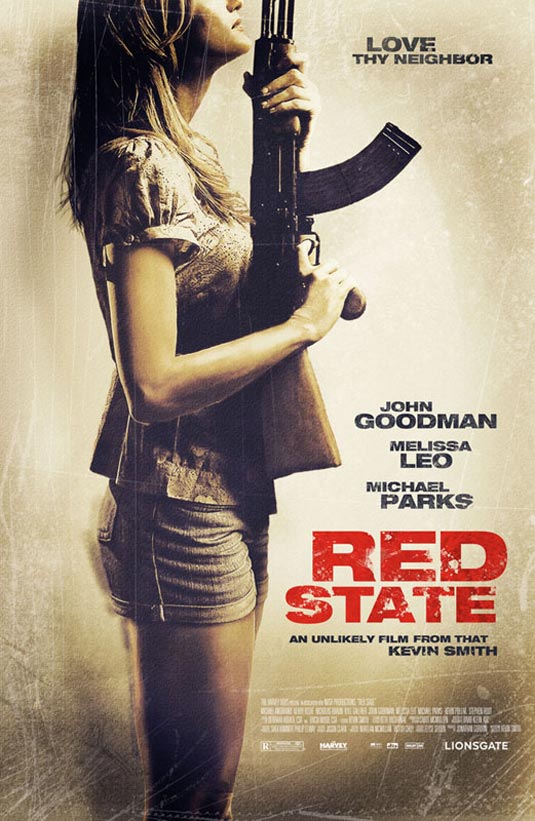
That’s what Red State is: all action and no thought. It's cheap slight-of-hand masked as serious social commentary. Here Smith, breaking away from his typical comedy background, is trying to make a serious movie about serious subject matter. Stylistically it works just fine as unnerving, bargain basement grindhouse. Intellectually, the movie is a puff of smoke as our hands close on nothing but thin air.
The story focuses on a mad small town preacher named Abin Cooper (Michael Park in a riveting villain role) who is supposed to represent a Fred Phelps surrogate as him and his small family congregation picket outside the funeral of a locally murdered gay teen, waving signs that say the kid is on his way to hell and other such things. Cooper’s presence is so strong around town that a local high school teacher tells her class that not even the neo-Nazi’s want anything to do with him. This is the extent of characterization in Red State.
Then one night three kids sneak off to lose their virginity to a local girl they found online. This is Sara (Melissa Leo) who says no one it getting into her without getting at least two beers into them. The kids drink down and hit the floor. When they awaken they find themselves inside Cooper’s church as he preaches a sermon of hate and then watches as a gay man, bound in plastic wrap and tied to a cross, is murdered in cold blood.
An investigation ultimately brings around the ATF lead by Keenan (John Goodman), who’s orders are to kill everyone inside after a Davadian-like firefight breaks out. This is the extent of social commentary in Red State; that, oh gosh, maybe even the good guys aren't good guys in the end.
In the Q&A with Smith that followed the screening of Red State he indicated that his purpose for making the movie was to take a stance against organizations like Fred Phelps and his Westboro Baptist Church who commit acts of hate in the name of God. This subject matter is exactly the problem as it's too large for a film of such small ambitions. That Smith has no agenda other than to cut down people like Phelps, he see the church people as no more than villains. What Smith fails to realize is that great drama is created in the grey areas that exist between ingrained social concepts of good and evil and how, as humans, people have the freedom to cross those lines at their own free will. It's not enough to show that someone drank the Koolaide when what's most interesting is understanding what forces would lead someone to such an act. The problem of the bicycle.
Instead, Smith has made what he himself deems a “parlour trick” of a movie in which twists are taken and bodies begin to drop, not so much in order to make any sort of statement, but rather for the director to toy with the audience. He’s proven now he can make a movie in another genre and make it well but Red State too often plays too much like the same kid just in a different candy store.
And then the movie ends, not to give anything away, on several notes that I suppose Smith would like to think of as satire but which take a misguided b-movie and turn it into an ignorant one. These scenes reveal the true nature of Smith and his black and white playground politics and lead to a final line of dialogue which corrupts the movie, making Smith just as guilty as those he takes up arms against within the film. If Red State ultimately makes any statement at all it’s that not only am I right and they are wrong but let’s make fun of them for how wrong they are. That Smith can’t find a way to end his film in anything but his standard penis jokes and stoner references reflects the sad state of a boyish mentality trying to juggle with an adult concept.
Smith states that, before wrapping up his career as a filmmaker he wanted to make the kind of film that his contemporaries like Quentin Tarantino and the Cohen Bros make but that he felt he never had the kind of talent as a visual storyteller to pull-off. It’s a funny reference seeing as the Cohen Bros. masterpiece No Country for Old Man is a haunting tale of an evil force that is corrupting society, which is both masterful on a suspense level as well as sending out a haunting warning call about the society we life in. That’s what, I think, Red State ultimately aims for, but Smith never even tries to deal with the idea of evil within society or take account for the ideas he wishes to explore. He's too busy making cheap entertainment for that.
There’s no doubt that Kevin Smith is a talented guy. In the comedy realm he has made some singular films which define their generation and has a voice for dialogue that, like David Mamet, Tarantino or Neil Labute is instantly recognizable as his own. But within the realm of drama and suspense Smith is lost in a sea of his own shortcomings, never being able to decide if he’s making a statement or making the kind of entertainment that gets an audience hooting and hollering. He used to make smart movies for dumb people. Now he has, unfortunately, made nothing more than a dumb movie for smart people.

 The first time I saw Donnie Darko was when it first came out on VHS. A couple of DVD's were around at that time but the technology was just emerging and certainly too expensive for my family to invest in at that point, which was fine with me as I am generally not well receptive to change. I had no idea what the movie was at the time other than that I had seen a preview for it on some other VHS I had recently rented and thought it looked alright. That of course was the sweet summer between grade 10 and 11 when I would watch anything that had a cool enough video box regardless of whether it was released theatrically or straight-to-video. I had already gotten into writing reviews at this time and had made the decision that one day I would be a professional critic (I think my original review still exists on IMDB somewhere, spelling mistakes and all).
What played before me, at the time, I considered an act of absolute brilliance. Of course, back then, when you're young and think you know something about something, Donnie Darko was just the thing I needed. Here I was, 16 or somewhere there around, working the film out over and over in my head, connecting the dots, making huge, brilliant discoveries about life and love and fear and death. I thought I had seen a masterpiece.
Soon after I got a DVD player and slowly started collecting them. Donnie Darko was one of my first purchases. I intended to watch it over and over and over again in my lifetime.
I just watched Donnie Darko for the second time tonight, Saturday February 27, 2010. I watched it because I want to sell off some DVDs and thought it might be one of them. Over the span on those years I've grown. I now hold a major in Film Studies, I've had reviews published and presented at a prestigious film conference, I've even gotten an e mail from Roger Ebert complimenting my writing, and, most importantly, I've watched some of the greatest films ever made.
Needless to say I don't feel the same about Donnie Darko. One of us apparently hasn't aged well. I can admire the craft of it's making, the professionalism of it's performances, but now I've learned that ideas are not what makes a film great or not, it's how it goes about presenting them (Roger Ebert once said, "It's not what a film is about that makes it good or not. It's how it's about it."), and an over-emphasis on film style doesn't impress me nearly as much as it once did.
In reality, Donnie Darko is one of those stepping stone pictures. Like Fight Club, The Boondock Saints or The Usual Suspects, to name a few, young people discover them and latch on to them because they are like nothing they have ever seen before. Every independent thinking, individualistic teenager wants to have something that they can hold above everyone else; something that speaks to them in volumes that their brainless colleagues could never comprehend, until they grow up, see more movies (better movies), and finally realize that those films are no more than empty-headed and empty-hearted excursions into style, with shallow philosophies that serve only themselves, not the stories.
That was Donnie Darko to me. I'm glad I got out of that stage. Some people never do. I think Kevin Smith said it best on one of his Evening With... DVDs when he made the comment that not even writer/director Richard Kelly knows what Donnie Darko is about. The comment was in jest but that basically sums it up. Kelly has no overarching approach to this material. He has no one specific thing he is trying to say, so he says them all and hopes maybe one or two stick.
I know, I know there's all this contradictory imagery that shows the duality of the human psyche, and I get that, but so what? Does that automatically make the movie good? What does it have to do with time travel? By the time the movie rolls around into it's third act and starts looping back upon time and upon itself and we are treated to a conclusion that is more ironic than anything, you finally see what Kelly's point was: to try to hold this thing together for just under 2 hours. That he does it is commendable. But it still doesn't make the movie a success.
To put imagery in a movie and assume it speaks for itself isn't enough. The golden rule of style is that form must equal function. You cannot separate the story from the style. As Godard once said, they create each other. That's the mistake Donnie Darko makes: it doesn't provide an adequate story to back up it's symbolism. I can see why a lot of kids would connect with Donnie Darko. He's a depressed, dissatisfied youth, wandering through life just trying to find something meaningful. I obviously connected with that once upon a time myself. Now though, his journey just seems in vein because Kelly doesn't allow him to find that meaning. At the end, Darko isn't a kid on the verge of grand epiphany, he's just some character in some minor, hip indie flick that goes through the motions of being some character in some minor, hip indie flick. And that's about it really.
The first time I saw Donnie Darko was when it first came out on VHS. A couple of DVD's were around at that time but the technology was just emerging and certainly too expensive for my family to invest in at that point, which was fine with me as I am generally not well receptive to change. I had no idea what the movie was at the time other than that I had seen a preview for it on some other VHS I had recently rented and thought it looked alright. That of course was the sweet summer between grade 10 and 11 when I would watch anything that had a cool enough video box regardless of whether it was released theatrically or straight-to-video. I had already gotten into writing reviews at this time and had made the decision that one day I would be a professional critic (I think my original review still exists on IMDB somewhere, spelling mistakes and all).
What played before me, at the time, I considered an act of absolute brilliance. Of course, back then, when you're young and think you know something about something, Donnie Darko was just the thing I needed. Here I was, 16 or somewhere there around, working the film out over and over in my head, connecting the dots, making huge, brilliant discoveries about life and love and fear and death. I thought I had seen a masterpiece.
Soon after I got a DVD player and slowly started collecting them. Donnie Darko was one of my first purchases. I intended to watch it over and over and over again in my lifetime.
I just watched Donnie Darko for the second time tonight, Saturday February 27, 2010. I watched it because I want to sell off some DVDs and thought it might be one of them. Over the span on those years I've grown. I now hold a major in Film Studies, I've had reviews published and presented at a prestigious film conference, I've even gotten an e mail from Roger Ebert complimenting my writing, and, most importantly, I've watched some of the greatest films ever made.
Needless to say I don't feel the same about Donnie Darko. One of us apparently hasn't aged well. I can admire the craft of it's making, the professionalism of it's performances, but now I've learned that ideas are not what makes a film great or not, it's how it goes about presenting them (Roger Ebert once said, "It's not what a film is about that makes it good or not. It's how it's about it."), and an over-emphasis on film style doesn't impress me nearly as much as it once did.
In reality, Donnie Darko is one of those stepping stone pictures. Like Fight Club, The Boondock Saints or The Usual Suspects, to name a few, young people discover them and latch on to them because they are like nothing they have ever seen before. Every independent thinking, individualistic teenager wants to have something that they can hold above everyone else; something that speaks to them in volumes that their brainless colleagues could never comprehend, until they grow up, see more movies (better movies), and finally realize that those films are no more than empty-headed and empty-hearted excursions into style, with shallow philosophies that serve only themselves, not the stories.
That was Donnie Darko to me. I'm glad I got out of that stage. Some people never do. I think Kevin Smith said it best on one of his Evening With... DVDs when he made the comment that not even writer/director Richard Kelly knows what Donnie Darko is about. The comment was in jest but that basically sums it up. Kelly has no overarching approach to this material. He has no one specific thing he is trying to say, so he says them all and hopes maybe one or two stick.
I know, I know there's all this contradictory imagery that shows the duality of the human psyche, and I get that, but so what? Does that automatically make the movie good? What does it have to do with time travel? By the time the movie rolls around into it's third act and starts looping back upon time and upon itself and we are treated to a conclusion that is more ironic than anything, you finally see what Kelly's point was: to try to hold this thing together for just under 2 hours. That he does it is commendable. But it still doesn't make the movie a success.
To put imagery in a movie and assume it speaks for itself isn't enough. The golden rule of style is that form must equal function. You cannot separate the story from the style. As Godard once said, they create each other. That's the mistake Donnie Darko makes: it doesn't provide an adequate story to back up it's symbolism. I can see why a lot of kids would connect with Donnie Darko. He's a depressed, dissatisfied youth, wandering through life just trying to find something meaningful. I obviously connected with that once upon a time myself. Now though, his journey just seems in vein because Kelly doesn't allow him to find that meaning. At the end, Darko isn't a kid on the verge of grand epiphany, he's just some character in some minor, hip indie flick that goes through the motions of being some character in some minor, hip indie flick. And that's about it really.
