Showing posts with label Ryan Gosling. Show all posts

Wednesday, June 12, 2013

A Few Words on writer/director/artist/genius Alejandro Jodorowsky

Have you ever seen an Alejandro Jodorowsky film?

How about Fando y Lis?


What about El Topo?


Holy Mountain anyone?


If you have, consider yourself lucky. If not, stop what you are doing, go out, and find one. Jodorowsky, after all is in the same business as Andrei Trakovsky, Ingmar Bergman, Stanley Kubrick, Terrance Malick, David Lynch, etc. which is to say the art business. The masterpiece business.

Jodorowsky is maybe the most influential filmmaker whose influence has gone mostly unsung. His 1970 film El Topo essentially invented the American Midnight Movie phenomenon and then quickly disappeared until 2007 when a box set of his best work was released.

The three second version of why this was: John Lennon saw and loved El Topo, convinced his man Allen Klein to distribute that flick and foot the bill for it's follow-up Holy Mountain. However, a falling out resulted in the films being yanked from distribution and basically locked away.


But you've seen Jodorowsky's influence everywhere. Nary has a Marilyn Manson video not provided at least some kind of wink and nod to Jordorwosky (his Shia LaBeouf-directed video for Born Villain even directly quotes Holy Mountain)

I should probably throw out that this video is very NSFW.


And what do you know, the new Ryan Gosling/Nicholas Winding Refn pretentious art-film piece of shit collaboration Only God Forgives is dedicated to Jodorowsky.


But now, I'm poking fun and getting off track.

Okay sure, Jodorwosky's films are violent:

Surreal:


And blasphemous:


And boy, you thought the iguana's in Werner Herzog's Bad Lieutenant: Port of Call New Orleans were weird?


Well how about the Conquest of Mexico reenacted with frogs and lizards?


But now I'm reducing Jordowosky to no more than a weirdo whose films should be shared with a group and a bong.


Well, ya, but anyone who has read this space on a regular basis knows that I also believe in art, especially trash art, and art Jodorowsky most defiantly is.

What's my definition of art? I think film becomes art when it meets two sets of criteria:

1) It fully utilizes the power of film as a visual medium:


And 2) it transcends the filmic medium. What the fuck does that mean? When you take the film away, you're still left with ideas, ways of thinking, emotions, whatever, that exist outside of the running time of the film. The ideas are what's important, the film is simply the medium which brings them to life.

But alas, what Ryan Gosling going on a violent killing spree or Marilyn Manson finding eyeballs in vaginas, etc lacks is that the films of Alejandro Jodorowsky, if you can brave them, are also beautiful, spiritual and leave you feeling fully empowered. 

Jodorowsky, who, besides being a madman, is also an academic, writes books and conducts sessions in which he acts as a spiritual healer of sorts, is always pushing his viewers to find enlightenment. In El Topo his gunfighter is on a quest to kill four other master gunfighters, who each first deliver a powerful lesson to him, and in Holy Mountain, a group of people descend a mountain in hopes of finding enlightenment.

Being a visual artist, this is all hard to take in upon first view, especially for those not accustomed to stories being told almost solely through images. But it all really dates back to a performance that Jodorowsky wrote for famous French mime Marcel Maceau when he apprentices under him.


To paraphrase, the mime encounters three people along his journey, each of which he kills and tries to eat their heart. The third is a child. Once the child's heart is eaten, the mime is so overcome with guilt from what he has done that he kills himself and offers his heart back to the child so it can live again. A positive through negative; beauty through violence; enlightenment through knowledge; redemption through self sacrifice. We could go on all day.

So what's Jodorowsky's purpose? To find balance in life. That's where enlightenment is. To come to grips with oneself by destroying one's past self and being reborn from the ashes. Jodorowsky's teaching asks it's subjects to look back through their family tree, pinpoint the moment in life where some sort of negative force arose, and to give away all the baggage that has been building up over the years as a result of that action/situation/relationship/whatever it is that is holding you back. With nothing in one's past and with complete knowledge of oneself one can move forward facing outwards, looking ahead to new experience instead of back at old ones. Or something like that. 

If that's not a good definition of enlightenment, what is?

And, look, I didn't even need to drop any acid!


Side Note - The Dance of Reality, an autobiographical look at Jodorowsky's life in Chile and first film since 1990, is currently making the festival rounds and looks like it will be one to keep an eye out for.


Wednesday, November 9, 2011

Drive

Nicolas Winding Refn’s Drive is the kind of movie that makes you almost instantly want to watch a better one. In this case, for me, that better one is Sidney Lumet’s swan song masterpiece Before the Devil Knows You're Dead. Both films involve bad men dealing with even worse men, revolve around a crime gone horribly wrong and are both modern day reincarnations of the darkened and hardened crime films of the 70s and 80s(some of which Lumet himself masterminded).

But where the difference lies is that Before the Devil Knows You're Dead was about more than the crime. It was about the implications, the aftermaths, the consequences of being stuck in a horrible situation to which there is no simple escape and to which the easiest option is to dig oneself even deeper into the murk. When the shock and awe, the hard talk, the sudden bursts of violence and the fierce tough guy posturing came to a crashing halt, left behind in its wake were damaged men who had bitten off more than they could chew and didn't know what to do about it.

Refn sets himself on the way to the same kind of payoff with Drive but then he stops almost destructively short as he builds towards no payoff in particular. Here is a polished and well made film (as well made as any other crime odyssey that comes to mind) that is all posturing. The film sneers, flexes it’s muscle, exists under the subtle and haunting thump of slow motion images playing under pounding retro 80s synth pop and does not, for any one second, give you any reason to care about a single thing that is going on in it. If you want to get a cheap lesson in pure film style without the burden of enrolment costs, Drive might be right up your alley. If it is, however, depth, compassion, or something that resembles anything slightly human, Drive feels like it is mostly grinding gears.

Ryan Gosling plays the Driver. He has no name, which is about right as he is all business and procedure. By day he’s a mechanic and Hollywood stunt man. By night he’s the getaway driver for lowly crooks. He lives by his defined set of rules: he doesn’t carry a gun, he’ll give you five minutes in which he is all yours, a minute too much on either side and he’s gone. And all he does, period, is drive.

He works for Shannon (Breaking Bad’s Brian Cranston) who runs a garage, sets up the Driver’s stunt work and walks with the kind of limp that suggests that the shop probably isn't his sole source of income. He wants a loan to buy a race car which the Driver can drive and make them lots of money.

He approaches Rose (Albert Brooks in a long overdue dramatic role) for a payout and gets it. Rose is some kind of guy. Brooks brings something unassuming to the surface of the role, but this is the kind of man whose words speak louder than his actions. “My hands are kind of dirty” the Driver says when Rose extends it for a shake. “It’s okay”, Rose replies. “So are mine.”

Rose is business partners with a hothead named Nino (Ron Pearlman). Somehow, for reasons too convoluted to explain, the Driver takes a job to help out the recently released husband of his neighbour (Cary Mulligan) who he’s taken quite a shine to. The job gets botched, people end up dead, and the Driver ends up with a bag full of Nino’s money.

So goes the set-up which leads the somewhat effective and haunting opening scenes into a conclusion that is populated by short bursts of brutal graphic violence as the Driver and Rose both square off in an attempt to be the last man standing.

All of this, once again, brings to mind the hard-boiled, murky crime pictures of the 70s and 80s from Walter Hill’s The Driver to Michael Mann’s Thief. But where the film falters is in how content it is to simply get by with just being confined to homage. In terms of genre recreation, Refn does an excellent job, going through the motions from the slow tracking cameras, the tight two-shots, the suspense created not through unending stimulation but by taking a static scene and cutting between three or four set objects while tension mounts on the soundtrack. If nothing else, Drive does let us remember a time when action allowed us to breathe a little.

But the film never quite achieves anything more. Are we at the point in film history where films are praised for their ability to pay homage to a time when movies weren’t so bad? Is seeing something different that stands apart from the over stimulation of today’s action films so rare that we’ll heap praise upon the first one that seems destined to take a different approach? But homage is, at its worst, an ironic post-modern reconstruction of the spare parts of great films gone by. Where Before the Devil Knows You're Dead, to continue with the same example, took the elements and created something new and thrilling with them, Drive’s saving grace is that its irony doesn’t come served with the wink and smirk of most of today’s attempts at homage.

So what do we make of Drive? Who is it supposed to appeal to? What does it want to achieve except show one filmmaker's attempt to mask a shallow story with his ability to recreate the essence of genre’s past? Drive is an exceptionally well made film with a clear vision of what it should look and feel like; filled with good performances, knuckle grinding action in the tradition of the classic car chase movies, a bumping soundtrack and a lot of spilled blood. And then it ends, leaving you in no better or worse shape than when it came to you, to which you nod, give it some points for ambition and then walk away with the realization that the history is far more compelling than the history lesson.

Tuesday, August 30, 2011

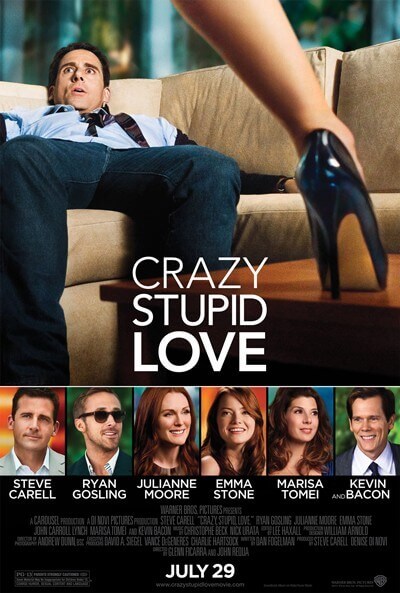
Crazy, Stupid Love

There’s a way some great actors just have of looking off into the distance that really becomes less about performance and more about finding true emotions. It’s a look without dialogue or anything more than a twist of the side of the mouth or a certain glint in the eye that hits something home, be it a man hugging his children or staring off as someone or something leaves him standing behind. It’s also a look that is most startling when comedic actors find it because it’s the moment that they feel comfortable enough with themselves to let the act down and bare some sort of true emotion. Steve Martin does it maybe better than anyone. Now Steve Carrel does it too, first with Dan in Real Life and now, in Crazy, Stupid, Love, he does it again.

It’s a look, especially now in 2011, that makes your realize that movies have become so big, dumb, artificial and ultimately meaningless, that it’s a small treasure to find on that exists at ground level and touches an audience because it deals with people and their actions instead of caricature and plot gimmicks. It’s a look, however that also, unfortunately, makes one wish it had found its way into a better movie.

And thus we have Crazy, Stupid, Love, which, despite its title, which promises insights into the strange, nonsensical, sloppy and completely unpredictable nature of love in real life, can’t muster up much more than to be a run of the mill romantic comedy. It tries too hard to be funny, not hard enough to be insightful, not much to be tightly structured and not at all to be anything more insightful than any other bi-weekly Hollywood romance. It’s good, but not good enough.

Thankfully it finds great actors to raise it into something enjoyable. Steve Carrel is warm, funny and human as Cal, long married to Emily (Julianne Moore). His blazer is too big, he wears running shoes with it, his wallet is Velcro and he’s more or less coasting through the routine his life has become. When Emily tells him she has had an affair with a colleague (Kevin Bacon who's name gets the film’s biggest laugh) and wants a divorce he doesn’t want to talk about it and instead, jumps out of the car to avoid her rambling. At least the pavement feels real.

Then one drunken night at the local haunt he comes across Jacob (Ryan Gosling) a smooth operator with the right suite, the right hair, the right shades, the right accent and the right lines. As, night after night, Jacob watches poor Cal make a drunken fool of himself at the bar he calls him over, tells him he reminds him of someone and says he will teach him everything he knows so he can get his life back together and pick up women so that he can get over Emily, his first and only love.

But then as Cal, after much funny teaching, starts to bag any woman he wants, Jacob meets Hannah (the lovely Emma Stone) who he fails to pick up but comes to him after one night realizing her relationship with her moron boyfriend is going nowhere fast. Hannah, for Jacob, is a game changer and slowly the two stories go their separate directions as Cal and Emily begin to realize their mistakes and Jacob begins to give up his ways.

All of this is nice and funny and sweet and utterly forgettable. If it wasn’t for the presence of Carrel, Stone, Moore and Gosling, the movie would be a redundant mess as it spins it’s wheels to an overblown and predictable conclusion.

But alas, in spite of unfortunate subplots in which Carrel dates a crazy grade school teacher played by Marissa Tomei and another strange and awkward one involving Cal’s family babysitter, the film is charming because it’s stars bring it warmth and humour. Carrel especially, under appreciated because he’s pigeonholed into playing morons, has a way of casting, as indicated in the opening paragraph, human glances across a screen that can either melt or lift your heart and Gosling, so very good in so many kinds of roles, finds a note for Jacob that is more about personality than caricature.

And that’s what the film offers: the pleasure of seeing the right actors come together and breathe life into an otherwise forgettable work. Crazy, Stupid, Love isn’t wholly realistic, doesn’t have any big moments of revelation like the best romantic comedies do and is more concerned with being clever and witty than about creating a full story that is engaging from beginning to end. These are intelligent and attractive actors. They know how to project humour and emotional depth in natural ways. Now that we’ve seen how good they can be in a film on autopilot let’s pray they find another one soon that is worthy of their talents.