Showing posts with label Ben Kingsley. Show all posts

Friday, March 8, 2013

Coming To A Theatre Near You: Iron Man 3 & The Hangover 3

The trailer/teaser for 2 of what can probably, with a large degree of accuracy, be described as two of the most anticipated blockbusters for the summer of 2013 season are out and hey look, they basically have the same poster:


Let's start with Iron Man 3


So I guess Ben Kingsley is going to show up looking like this:


Awesome. If anyone can play that costume it's Kingsley because he's British and they, ya know, invented acting or something.

He stars as villain The Mandarin, which will probably mean more to Iron Man fans than it does to me, having touched a girl before and all


Promising is that nowhere do any of the ads or the film's IMDB page indicate that Samuel L. Jackson will be appearing as Nick Fury, whose presence in the Iron Man 2 resulted in an entire second act product placement for the then upcoming Avengers film


Not so promising is the teaser for The Hangover Part 3:


We're promised "The epic conclusion to the trilogy of mayhem and bad decisions." This statement, of course, ignores the fact that the first film was a complete, self contained entity and it's sequel no more than a lazy remake with twice as much irreverence as the first.

Number 3 looks to be in about the same boat as the boys retread the same jokes and story for a third time. From the lame cutaway shot that reveals Alan (Zach Galifianakis) singing that opens the teaser to the last in which a giraffe has an unfortunate encounter with a concrete bridge (okay, that might be funny), it all reeks of been there done that...TWICE.

On a closing note, if anyone has any clips or knows any instances of Ken Jeong being funny please send them to me immediately as I'd hate to go through the rest of my life believing that this man has never done a single funny thing in his career...Ever...Like really...


Monday, December 5, 2011

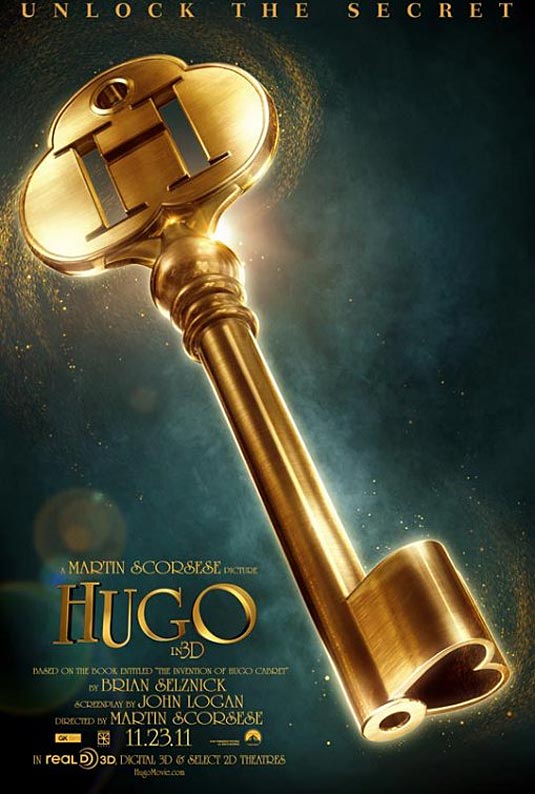
Hugo

At the age of 69 Martin Scorsese will direct films after Hugo. Some of them, if not most of them, will be great and some of them may even still be on the lips of many long after both America’s greatest living filmmaker has passed on and the sound of Hugo has gone silent. But it’s safe to say that, no matter how many films are still to come from Scorsese, and no matter their quality, none of them will be as beautiful, touching or personal as Hugo. Martin Scorsese has, one film at a time, become the very definition of American film. But he’s no longer that young kid from New York trying to push boundaries and change the landscape of film as we know it. He’s already been there and done that. Now he’s that wise old man, none of the ambition or vision having faded, who looks back at it all and sees just what it has meant. There will not, I think it’s fairly safe to say, be a more magical film released in 2011 than Hugo.

Disguised in the veil of grand family adventure, Hugo is a film that tells the tale of a young boy in Paris. His father (Jude Law) was a clockmaker who loved to tinker and fix things. Together they fixed old gizmos, so primitive by today’s standards that it’s a marvel they even worked at all, went to the movies, and loved each other very much. The father’s swan song was to be fixing up an old mechanical man called an Automaton. These were essentially life-like wind up toys designed to, when wound, perform human tasks. When Hugo’s father finds an old one forgotten in a museum he brings it home to fix. This one is a writer, but before it can again put pen to page an accident happens and Hugo is left an orphan.

He’s taken in by his alcoholic uncle Claude (Ray Winstone) whose job it is to see that all the clocks at the local train station are in working order. Once the boy is taught how to operate the clocks he is left alone to perform the man’s duties and continue fixing the Automaton while constantly evading the pursuits of the Chaplinesque Station Inspector (Sacha Baron Cohen) who hates orphans.

In order to fix the Automaton, Hugo begins stealing parts from George (Ben Kingsly) an old man who owns a meagre toy shop in the station. When George catches Hugo in the act he takes the boy’s notebook, the contents of which, mysteriously upset him. Hugo enlists the help of George’s adopted god daughter Isabelle (Chloe Grace Mortez) who is an avid reader, has never seen a movie and is looking desperately for a real life adventure.

Scorsese and his writer John Logan, like master storytellers, allow this story to unfold gradually, not revealing all of its secrets up front. This allows the revelation of George’s true identity and the children’s quest to find the missing pieces of the Automaton, and how it’s existence is connected to him, to take the film out of grand family entertainment and slowly reveal a loving ode to the magic of cinema and all of it’s history.

I dare not say another word for fear of revealing anything. Some reviews have pegged Hugo as being a film about the importance of film preservation and restoration. Knowing Scorsese and all his recent invaluable efforts towards these practices it’s a fair assessment, but misses the point. This is not a film about why we should restore old films, but one about the magic that is inherent in them and how that magic shapes and changes our lives from the untold joys they unlock in the imagination of children, to the sweet and tender reflections of times gone past they aspire in adults. Films are, at their very greatest, both dream and memory all wrapped into one. This must have certainly wrung true for Scorsese, one of, if not the most well versed filmmakers working today.

But the key to Hugo is not that it’s a self congratulatory pat on the back to those who are well versed enough to know the film history that it pays such loving tribute to. It is rather, like Woody Allen’s Midnight in Paris, a tip of the hat to the works of art that defined the medium as we know it, while still creating something new and modern with the love that these reflections of the past have created. Hugo is thus, above all, the perfect anachronism.

So then the question remains, in an age where family films have become lightning paced flashes of colour and sound, will children be able to accept Hugo? Yes, I think, for some they will. Smart, mature ones will especially appreciate it; ones with grand creative imaginations who look at the world and see the magic of endless possibility. It will also appeal to the children who’s bodies have grown and aged but who’s minds have stayed young and alive and the children who are now falling somewhere in between.

Hugo may be a film about film history and other such adult topics mostly left to academia, but it’s also about so much more and so much less than that. It’s proof that happy endings don’t just happen in the movies. They happen between the seats of every theatre all over the world.

Thursday, March 4, 2010

Shutter Island

The boat rolls out of a fog so dense that it renders everything a brilliant white. It might as well be sailing straight out of 50s film noir. Aboard it U.S. Marshall Teddy Daniels vomits violently in the washroom. This is a man who has not repented for the sins of his past and carries that burden atop his every move. As an agent he looks the part: tan suit, sharp hat; the whole nine. As played by Leonardo DiCaprio he’s a seasoned professional: been too many places to be much surprised anymore and seen too many things to much care. And yet he carries hidden secrets in the way he holds his shoulders and hangs his head. To him, this new case at the state run mental hospital for the criminally insane will be an in-and-out job but his partner Chuck knows better, “If these guys only heard voices and chased butterflies they wouldn’t need us.” The men are escorted to an entrance gate, surrounded by looming brick walls and guarded by emotionless men with big guns. They are instructed to hand over their weapons because, as a state run facility, it is the law that the guards carry rank over the cops. They’ll play by their rules or not play at all. While a storm brews outside they are lead to Dr. Cawley, the man in charge. He is played by Ben Kingsley which means he is proper, well-spoken and pristinely mannered, while also managing to give the feeling of always holding something back. It doesn’t help that his colleague at the institution is played by Max von Sydow who has made a career out of always holding back deep secrets that give off ominous tones. That’s the set-up to Martin Scorsese’s Shutter Island, the director’s first excursion back into thriller territory since Cape Fear and his first into classic horror and film noir. Two Boston cops are sent to the isolated institution in order to track down an escaped patient that no one will admit to having seen escape or know exactly how she went about it. “It’s as if she just evaporated through the walls,” assesses Cawley, and he may be right; there seems to be a lot of spirits haunting the walls of Shudder Island, or at least the pain of their memories. The girl in question is Rachel, who drowned her three children and still, according to Dr. Cawley, has no idea what she has done or that she is even in an institution. The grounds are divided into three buildings, a ward for the men, a ward for the women and Ward C, which used to be an old Civil War post and houses the most dangerous criminals. No one is allowed access to Ward C without the accompaniment of both Cawley and the warden. As the investigation progresses Teddy is attacked by migraines and visions of his wife who was killed in a fire and to his days during World War II in which he saw dozens of men slaughtered without mercy in a concentration camp. As the investigation progresses and Teddy gets closer to uncovering the truth, his inner demons take him closer and closer to the physiological breaking point. What about the institution that triggers these dark feelings in Teddy is one of its many secrets, of which I dare not continue to hint at. This is a brilliant set-up for Martin Scorsese to evoke that golden period of classic horror and film noir, which consisted of wounded men carrying their emotional baggage around on their shoulders, drifting from one job to the next, always searching for some sort of inner redemption that is just out of reach. Here Scorsese once again proves himself the master of tones and moods, of implying more by showing less. Shutter Island is, if nothing more, a brilliant exercise in set design, lighting, costumes and editing. Every frame is meticulously constructed to convey the sinister undercurrents that could lie around every dark, damp corner of the wards. Consider the way Scorsese slowly tracks the camera through desolate spaces in ominous point-of-view shots; how high angles reveal labyrinth mazes of unending stairs and corridors; or how the camera cranes up from close-ups to reveal imminent danger lurking in the background. Not to mention Ward C, when Teddy finally gets there. It’s a virtual hell-on-earth that will go down as one of the great horror sequences of its time. As a thriller, the first two thirds of Shutter Island are riveting and we eagerly anticipate what new tricks Scorsese has up his sleeve. And then, as most thrillers tend to do, the film loses touch in an effort to ceaselessly explain itself (a verbal description in the third act is followed by a flashback that visually depicts the exact same thing) and we’re left with another case of the explanation being of much less value than the buildup, leaving the sinking realization that the material has no intention of rising to the occasion that Scorsese and his actors have set for it, leaving the director trying to pull rabbits out of empty hats. And yet Scorsese’s brilliance as a filmmaker still stands outside of the story and keeps the wheels spinning. The filmmaker’s mastery of his craft oozes into every perfectly constructed shot and the film thus, even when stalling, feels like a work of art to be hung on the wall and pondered over the delicacy of its creation. As the greatest living filmmaker working in America, Shutter Island will not be remembered as Scrosese’s best film. In lesser hands it wouldn’t even pass as a tolerable thriller and yet even as its plot crumbles down around it, as an evocation of a classic, long forgotten genre and all its moods, textures and surfaces, it is just about a perfect stylistic exercise.