
Saturday, February 13, 2010
Shorter Theatrical Runs at Warners Too
A couple days ago I posted about how Disney is trying out some experimental ways in which to release their films, the first of which will be to truncate the theatrical run of Tim Burton's Alice In Wonderland, which would mean taking the movie out of theaters roughly a month early in order to get it onto DVD and ondemand even faster. The question that plagued my mind about this is whether or not such a maneuver signals the beginning of the end for seeing movies theatrically, or just a nice roundabout way of saying that Alice in Wonderland is no good?
Now Hollywood Reporter is saying that Warner Bros. is also going to adopt the shortened theatrical run method too. Here's the scoop: Warner's is planning on doing the same thing to their fall movie Guardians of Ga'hoole (Zac Snyder's new animated film). The plan is to chop about a month off the initial run in order to have the product prepped for DVD and Blu-ray for Christmas. Similarly Disney is saying the reason for shortening Alice's run is so that it can be out on home video for summer.
What's also been revealed is that that studios have assured exhibitors that they will sweeten the deal by offering concessions on movies with shortened runs.
The studios have also promised that it will only do this to two movies a year: one in the spring and one in the fall. Of course, the exhibitors need to agree to take these movies out of theaters a month earlier than usual but really, what choice do they have? If they don't play ball with the studios, the studios won't schedule big movies for May and September, ultimately hurting theaters more than to just let the movies go early.
Something about these developments fascinates me. What does it imply about the future of exhibition; the future of distribution; the future of home video; the future of the film industry in general? Will two movies a year do anything to help out stuggling studios, especially when they are movies that will probably make big money no matter how fast they get to DVD? I guess all we can do is wait and see whether or not all the majors will adopt this system or whether or not it will reveal itself as a failed transgression and be quickly forgotten.

Thursday, February 11, 2010
John Hughes
 I just finished watching Don't you Forget About Me a documentary about a group of Canadian filmmakers who head for Chicago in order to snag a rare interview from iconic but reclusive filmmaker John Hughes who more or less disappeared from filmmaking in the late 90s and wasn't heard from again until his unexpected death last year.
The documentary itself isn't a great one. It really has no background on Hughes as a person or a filmmaker and only really focuses on his 80s teen comedy work neglecting his best film Planes, Trains and Automobiles or his later, lesser quality screenwriting efforts under a pseudonym, and of course, ends in anti-climax as Hughes does not accept the invitation to be interviewed.
However, one thing about the film struck me. The weight of the material comes from a combination of interviews with some of his actors, other filmmakers who he inspired (Kevin Smith, Jason Reitman), critic and fellow Chicagonians Roger Ebert and Richard Reoper and a bunch of high school kinds in an effort to show that contemporary teenage comedies are vapid and shallow and don't reflect what it is really like to be a teenager. "I've never had sex with a pie," one kid says. "But I've defiantly skipped class before."
Smith, Reitman and Howard Deutch (who directed Pretty in Pink and Some Kind of Wonderful) along with all the kids interviewed throw the term realism around a lot in relation to Hughes' work. They say that Hughes was so influential because you could go to his movies on a Friday night and see yourself projected up on that screen. Some people claim they knew and were friends with kids like the ones in Hughes' movies, and that no one has ever gotten that formula quite right again.
I'll agree with the second point: no one indeed has ever gotten it quite right again (although I think there is maybe more truth to some of the more tender moments in American Pie than the kid in question is letting on). Indeed, teenage comedies over the years have become shallow, juvenile, gross and stupid and do not reflect what it is truly like to be a teenager in the midst of growing up.
There aren't movies about kids just hanging out anymore, having fun, wandering aimlessly, trying to find themselves when they can muster up the energy to do so, and so on. That was Hughes at his best within those teen films. A lot of people in the documentary say things like The Breakfast Club could never have been made today or people like Molly Ringwald could never be stars: it was too talky, too boring and she was too average, too ordinary; that her persona didn't come with enough baggage to be flaunted in public. They are probably right.
All of that is fine and dandy and, most of all, true. But I wonder just how much closer John Hughes actually got to reality than any other filmmaker ever does? My high school experience never mimicked anything like what is depicted in those films and this brings me to my reservations about using the word reality in regards to film.
Simply put, realism in movies doesn't exist. Critics talk about it all the time. Andre Bazin constantly touted realism in film and dismissed anything that came with even the slightest hint of artificiality (Jim Emerson posted a good article on this topic over at Scanners earlier today).
However, the realism that Andre Bazin and other critics talk about is not the realism of the everyday. It is cinematic realism. It's about finding something realistic within the context of a given film. Is the story plausible? Do the characters act in the ways we believe they would act in such a situation? I didn't believe a moment of The Dark Knight as creating a plausible, realistic world, but the film creates the aura that these people would genuinely exist in such a world and act in the exact manner in which they were acting. That's cinematic realism.
This brings me to a question that was posed to me in a grade 11 Media Studies class. The question was whether art imitates life or life imitates art. It seems like one of those impossible questions with no right answer, like what came first, the chicken or the egg? But then it becomes clear. The answer is that it's a two way street: each are a reflection of the other. In other words, we'd like to think we talk and act like they do in the movies and the movies would like to think they talk and act like we do in real life.
There's no doubt that, in those teen films, John Hughes was channelling people and places from his life and his youth; using something real as the template to cast his film against. However, are the films realistic in any sort of every day sense? I don't think so. Yet, the reason they are so affecting and people connect with them, enabling them to continue to live on these 20 years later, is because they offered an ideal portrait of what we wished out lives were like. To be as unique and innocent as Molly Ringwald, to be as hopelessly in love as Ducky, to be as rebellious...and so on.
John Hughes' method was then to create characters that represented types. They weren't typical teen characters: they were amalgamations of every kind of teenage archetype there was, and then put them into situations in which any teenager could possibly be confronted with: love, heartbreak, detention, an irate teacher, etc. However these things represented the ideals: the love was sweeter and more innocent than real life might be, the heartbreak more searing, the friendships more long lasting, whatever you will. These kids were the people we wanted to be, the friendships we wanted to have, the lives we wanted to lead, the things we wanted to stand for.
John Hughes' films didn't so much create a portrait of reality because, let's face it, if the movies really presented accurate visions of reality we would never go to them. We go to them to see things as better than they are, funnier, more exciting, more tragic, more anything other than what we know in the day to day. John Hughes just so happened to present those things within a world that didn't feel as if it was completely unattainable; that it just existed outside the grasp of human possibility. That's what Hughes did at his best. That's what made him special. That's true cinematic realism.
Wednesday, February 10, 2010
Something`s Fishy in Wonderland
 New Tim Burton films don't excite me. He's done some good work but, to be honest, I don`t think the man is a very good filmmaker. He`s an excellent decorator but a second rate storyteller, which means his films always end up feeling like hollow exercises in special effects and set design while the emotional crux of the stories take the back seat.
His approach to macabre subject matter doesn't much interest me either. I get that he is making films about outsiders cast away from society, but his satiric vision of the everyday life which he juxtaposes his characters against is, in and of itself, so over-the-top that he's not so much making a statement as making a misguided spectacle.
It should be no surprise then that, whether it's good or not, I'm not really excited about Burton's upcoming live-action-with-animation take of Alice in Wonderland, which is set for release on March 5th in both 2D and 3D formats.
What does interest me though is that Hollywood Reporter is saying that Disney is planning on taking an experimental approach to releasing the movie. Apparently Disney has been toying with different ideas on how to release movies and now it is time to put one into practice. So the idea is that Disney is approaching exhibitors about shortening Alice's run from roughly 16 weeks in first run theaters to around 13 or under. The reason for this is because Disney feels the film will be a big hit on DVD and ondemand services, so the quicker they can get it there the better.
What's unclear at this moment is, if studio's plan on adopting this method of distribution, how they plan on compensating theaters for shortening the runs of big films like Alice in Wonderland in order to push them onto DVD quicker. For theaters, shortened runs means less actual return from the studio on the film's actual business and less physical traffic through the theater as people may be encouraged to simply wait for the DVD, which translates into less traffic to the theater's concession stands; the place where most of an operation's profits come from.
Disney CEO Bob Iger has said that truncated runs could be a way to maximize the Disney's bottom line, but I don't quite buy it. Is this simply a sign that Disney has lost faith in Burton's project and doesn't believe it will perform much beyond the opening weekend? I can't imagine the studio pulling something like this with one of their big projects like a Pixar or Pirates of the Caribbean film. Or is this one last desperate attempt by studios in hard times to keep people going out to the movies before everything except tentpole pictures and arthouse fare go more or less straight to video and ondemand?
It will be interesting to see how Burton, who began his career as an animator at Disney, will respond to his movie being the lab rat in such an experiment.
Sunday, February 7, 2010
The Celebrity Connection
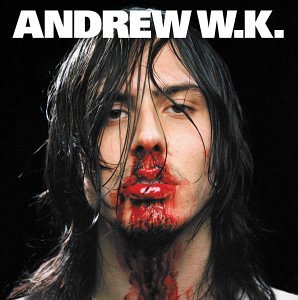
Andrew W.K. was that rocker dude in the early 2000s who wore all white, talked in insane tongues, wrote infectiously catchy rock songs like Party Hard and She is Beautiful, and was supposed to be the golden saviour of rock, only for his career to fizzle out after his third album was never released in North America.
Well apparently, there have been rumours going around that Andrew W.K. might not be real after some cryptic comments he made during a lecture about how he isn't the same person now as he was back then. Collages have been made comparing his early pictures to more recent ones and, although the similarities are there, there are also just enough differences to believe that he just maybe isn't the same guy. Thus, it has been speculated that Andrew W.K. is a fictional character that his record label created and has been played by different actors over the years.
Anyway, whether Andrew W.K. is real or just a character isn't the point. What matters is that this got me thinking about another big celebrity in the movie world who may just be a fictional character played by someone else. Check it out:


Could Michael Bay really just be Michael Bolton in disguise? You decide.
Thursday, February 4, 2010
The Tom Cruise Look
Since I am a tad compulsive and can't stand disorganization, all of my DVDs are shelved in alphabetical order. Therefore, for as long as I've had DVDs, Mission Impossible 2 and Minority Report have always sat next to each other on my shelf. And then one day I got to looking at them and realized that, hey, they both basically have the exact same cover. And then I hit up Google and discovered that the majority of Tom Cruise starring movies feature the actor in variations of the exact same pose on the movie posters or DVD covers. It's always him in profile, from the side. You can see it start to take shape with Risky Business poster and evolves from there. I therefore thought it would be pertinent to share this new discovery of mine with all of you. Check it out:


Tuesday, February 2, 2010
Oscar Nominations Are Out
 Of course, today is the day where every critic and blogger weighs in on the pleasant surprises and bitter disappointments of this years Oscar nominees, which were announced today. I won't go over them in a super amount of detail seeing as so many people already have, but I will make a few small observations and ideas on who I think will win in each category.
- Meryl Streep is, not surprisingly, nominated for her performance as Julia Child in Julie and Julia. It's another example of a mediocre movie getting recognized come awards season just because of Streep. Who will win is kind of a toss up in this category. It's nice that two youngins were nominated for Best Actress in Carey Mulligan for An Education and Gabourey Sidibe for Precious, but considering the year Sandra Bullock is having she may end up grabbing the award for The Blind Side.
- Best actor will go to Jeff Bridges for Crazy Heart. That's all there is to say here.
- A couple of surprises for the supporting actor category came in Woody Harrelson for The Messengers and Christopher Plummer as Leo Tolstoy in The Last Station, but neither of them will dismount Christoph Waltz as the villain in Inglourious Basterds who has been expected to win since the moment the film debuted at Cannes.
- Supporting Actress will go to Mo'Nique for her amazing performance in Precious. Penelope Cruz is a surprise as she nabbed a nomination for her performance in Nine, the under preforming, uninspired musical remake of Fellini's 8 1/2. This adds special irony to the underground rumblings that the Weinstein Company had paid their way to a Golden Globe win for the film. However, it wouldn't be a true Oscar ceremony without Harvey Weinstein sneaking in someone in a role that doesn't deserve the recognition.
- Will the animation category be shaken this year with Pixar's Up scoring a Best Picture nomination? The one entry that offered it any competition, Ponyo, is absent from the category.
- Once again Pedro Almodovar gets completely overlooked in the Foreign Film category, not snagging a nomination for his Broken Embraces. Although the Academy has pulled some fast ones in this category in the past (Pan's Labyrinth losing to Lives of Others in 2007), Michael Haneke's White Ribbon seems to be the front-runner here.
- As good as Inglourious Basterds and Up in the Air are, the clear competition in the Best Director category will be between former spouses James Cameron for Avatar and Kathryn Bigelow for The Hurt Locker. Cameron won the Golden Globe, Bigelow won the Director's Guild prize. The Director's Guild is usually the best predictor. Although I think Precious is a decent movie, I don't think Lee Daniels is a good enough filmmaker to be a competator.
- And now, Best Picture. There are 10 nominations this year. I don't think there needs to be, as none of the other 5 seem like they have a chance against the five that would have been up for nomination in the first place (Avatar, The Hurt Locker, Up in the Air, Precious and Inglourious Basterds). I appreciate seeing the Coen Bros.' A Serious Man getting some recognition and Up gets a spot for animation, but really, District 9? Of all the good blockbuster entertainments in 2009, was District 9 really better than The Hangover or 500 Days of Summer?
- Once again, Best picture will come down to The Hurt Locker and Avatar.
- The Blind Side is also up for best picture. I haven't seen it and have sort of purposely avoided it because, even though it could be an uplifting and moving experience, I'm still a little skeptical about how, in 2009, Hollywood still feels that it needs a white person to tell a black person's story.
- Finally, I'll repost a comment I left over at Sergio Leone and the Lefthand Fly Rule about the Academy's decision to have 10 nominees for best picture in order to hopefully open up the awards and let in films that were known more for their popularity than artistic merit:
Monday, February 1, 2010
Crazy Heart
 Real country music (not that silly, poppy, beer for my horses kind of stuff) is a contradiction if you think about it. It is one of the simplest, saddest forms of music there has ever been and yet, in execution, it can be both upbeat and catchy. That’s essentially the driving truth behind Crazy Heart, which is not quite a tragedy but not quite a happily ever after story either. When washed up, alcoholic country legend Bad Blake (Jeff Bridges) is asked by a reporter where all those songs came from his answer comes with only half a grin: “Unfortunately, they came from life.” It’s no surprise then that the chorus to Blake’s biggest hit Fallin’ and Flyin’ ponders: “Funny how fallin’ feels like flyin’ for a little while.” If anyone should know…
The contradiction of country music is thus also the contradiction of Bad Blake as well. He’s washed up, finishes a cigarette with another, is a thankless alcoholic, hasn’t written a new song in years and drives himself to bowling alley gigs in his old beater only to spend much of the time backstage with his head in the toilet bowl, while his young protégée Tommy Sweet is selling out stadiums on the back of his solo work.
There’s a point it seems, in the career of any legendary musician, in which music stops being one’s job and starts being their biggest inconvenience; a mandatory disruption between binges. That’s the stage Blake has gotten himself into. And yet, on stage, singing those depressing songs, is when Blake is most truly alive and his performance glistens with power and energy. It’s a chore to get to the stage, but once there Blake is encapsulated by the power of his own songs. It’s at these times that one realizes that Blake isn’t a ghost of a former time, but simply a wanderer, damned to haunt the purgatories of Santa Fe as a man bearing the burden of his former excesses.
And then things seem to look up as Blake staggers from one meaningless episode to the next. His first big break in life is the relationship that forms between him and the reporter Jean Craddock (Maggie Gyllenhaal) who comes for an interview and leaves with his heart. She’s a little broken herself, raising a child from a marriage that was a mistake, and sees something in him. Maybe it’s in the songs. She knows the risks, but takes the plunge anyway; thinking maybe saving Blake could atone for her own past mistakes even while knowing better than that at the same time. What Blake finds in return, through her son Buddy, is what he himself has lost with his own estranged son that he has not seen since the boy was four.
Their relationship is a complex one because it grows under the knowledge that, no matter how much she loves him, no matter how good he is with the kid, at the end of the day Blake is still an addict and all an addict truly cares about is how to get their next fix. This leads to a key scene in a shopping mall in which Blake hits rock bottom and the film pulls the rug out from under us as a reminder that this isn’t just some conventional redemption story. Blake is a flawed man and, despite how much our hearts go out to him and how often we see that he is capable of good, he is not infallible and relapse is part of his nature. At times like these, the film subtly reveals that it knows a lot about addiction without ever really being about it.
That’s essentially the approach the entire film takes, revealing itself subtly, never passing judgement on its characters or forcing them down paths they needn’t go. It’s not so much concerned with following a conventional story as it is in showing how life is random and episodic and, despite our best efforts to the contrary, can turn on us at any moment. Blake is neither a hero nor a villain; he’s just another guy playing the cards he has been dealt. Sometimes he wins a hand. Most times he doesn’t.
There’s not a lot to say about Jeff Bridges that hasn’t already been said. He is, indeed, one of America’s most gifted and consistent actors. The entire film rests squarely on his ability to make an audience sympathize with Blake while never quite making them feel sorry for him.
There are also small but significant moments for Collin Farrell as Tommy Sweet and Robert DuVall as Blake’s old friend. The film is wise to not develop these characters into subplots that could build into a story, not simply for the fact that it prevents them from succumbing to all the dramatic clichés this kind of story is prone to but, like everyone else in Blake’s life, it makes them feel just like what they are: random faces along the path to nowhere in particular.
Subscribe to:
Posts (Atom)