Showing posts with label Michael Bay. Show all posts

Tuesday, November 13, 2012

Bad Boys: Whatcha Gonna Do?


Okay so wait!

There's these two black cops. They're partners. One, Mike Lowrey is a young, drop dead beautiful hunk of negro who, in the third person declares "Fuck anyone who don't like Mike Lowery", and isn't afraid to pull his gun and shoot first whenever needed, the law be damned. The other is short, slightly hot headed, has a wife, 4 kids, a lot of expenses and a desperate need to keep his job.

Their biggest bust at this point is like a kajllion pounds of heroin. In order to keep the toxic drug fumes out of the the evidence room and encourage air flow a ventilation fan is conveniently installed and acts as a way for a European criminal nutbag to break in and steal the entire bust. This dude is a strong case for tightening immigration laws in America. He's mean and killin' the holy fuck out of anyone who crosses him, one of  whom, in this case, just so happens to be, at the time, with a whore...er...escort who also just so happens to know one Mike Lowery.

But oh wait. It thickens. Along for the job with the whr...escort is a friend, played by Tia Leoni, who witnesses both her friend and the client get taken out by that crazy Turkish fucker. Luckily, just moments prior to the blood bath she excuses herself to go to the washroom.

Unfortunately she's spotted and narrowly escapes a lot of bullets. In a panic she calls the one person who she feels she can trust: the dead escort's most recent contact, Mike Lowery. Only problem is when she makes the call to the station, Mike Lowery ain't nowhere to be found. Who is? Marcus, his partner.

Chief, played by the can-never-be-blamed-for-bad-material Joey Pants, has a brilliant idea. Have Marcus pretend to be Lowery. Marcus ain't doin' it. Does Marcus like having a job? Yeah. Then Marcus is doing it!

Marcus takes the phone and flubs the hello. The chief holds him up. Marcus says "hole on" and puts his hand to the receiver long enough for an extended conversation where the chief tells him that he must sound more like this man that this girl has never spoken to in her life.

Okay, back on track. Marcus gets Leoni's address and heads over there. On the way from the car to the entrance he talks himself up. He's gotta act and sound, once again, like this man she has never met. He knocks. Who is it. It's Mike Lowery. How does she know it's him. He says "Mike Lowery" again and then again, expecting, I guess, that she'll find the answer to her hard question in Lowery's name.

The door opens. She comes at him with a baseball bat. Yada yada. He has had enough. Listen lady. I'm here to help so you so stop coming at me with a damn baseball bat or you're on your own. The small talk is cut short when bullets start rippin' through shit.

They're on the run. Marcus has to take her to a safe place. He's got it! Mike Lowery's place. Ah, I see, Marcus has easy access to Mike's apartment through playing tough guy with the gets-a-boner-every-time-he-thinks-of-what-it-would-be-like-to-be-a-cop front desk clerk whose presence will only lead to a useless-as-tits-on-a-bull scene in which said desk man gets to tell Marcus how much he wants to be a help with his case.

Marcus takes Leoni up to Mike's apartment, where he doesn't know where the light switch is. He donno where anything is. He always redecoratin' 'n shit, he helpfully explains. He walks backwards and falls. He donno why he fallin' 'n shit in a place he live.

Mike gets filled in on the whole situation the next day by chief in a tough assed monologue which ends with him telling both of them that they are going to keep up this little act so they don't lose their only witness. What!? Hell naw. Mike don't want no one messing up his expensive stuff and Marcus has a wife who is never going to allow this. Of course he does. Without her there would be no scene in which he packs his bags as shecan't handle much more of this, which manages to somehow also name drop Coke not once but thrice.


Back at Mike's, Leoni looks at the wall of pictures and wonders who the man in them are. It is, of course, the real Mike Lowery. Oh shit, sometimes I don't look at my shelf, I forget all the pittures I got here. That's my partner Marcus. He kindly explains to her that it's a cop thing. At Marcus' house is all pittures of him. Oh, I see, because when she first saw it she thought maybe it was pictures of his lover. Ah nah. He ain't gay. She buys it. Sheez, sometimes cop work can be hard.

Fuck me dead, I feel stupid! And we're only about half way through!

No wonder people blame Michael Bay for how shitty his movies are even though his team is what keeps production value high and action/melodrama pumping steadily across the running time. Take away the hunks, babes, special effects and speed and just, honestly and sincerely, look at his movies as fast paced photography. Dude knows how to turn an abysmal script into a great looking movie. Just prepare to get stupider for having seen them.

Except The Rock. That movie is (Rock) solid.

Wednesday, July 20, 2011

Transformers: Dark of the Moon

The third Transformers film Dark of the Moon has so much (too much really) spectacular action that it’s kind of a shame it got stuck with such a bad action movie. In Transformers 3 you will be treated to just about every kind of chase, stunt, explosion, shoot out, special effect, in the book plus the whole book and the kitchen sink as well. If that’s what you’re looking for, good for you. Look no further. Some people consider that getting their money’s worth and although the Transformers films have been a lot of things to a lot of people, boring they have not been. If however you want, oh I don’t know, say, filmmaking, storytelling, characters, drama, insight, depth, logic, common sense, continuity, or any other such endangered species to the Hollywood summer film landscape, well look elsewhere.


“But Hey!” some will scream. “How can you expect anything more from a Transformers movie when you know exactly what you’re getting before you even get it?” I don’t, but how, I retort, can you be satisfied with so much less? The Transformers films, I have realized, under the both flawed and brilliant reign of director Michael Bay, are not films at all but extended music videos in which there is only the outline of story, character, drama etc., and instead of music the quick, jagged images are instead made up of flashes of sound and colour. This is the cinema of banging and blowing up as enormous computer generated effects crash headfirst at high speed into other enormous computer generated effects in an orgasm of colour and noise. Transformers 3 is, if nothing else, certainly the loudest movie I have ever bared witness to.

In my last paragraph there I hinted at how Transformers could be so much more, but then again, I’m not sure, after all this, that it actually can be. Of the last film, the thoroughly unbearable Revenge of the Fallen, I complained of the function of the human characters who were essentially real faces that popped up amid the wall-to-wall animation and served no purpose other than to shout inane dialogue, run away from things exploding and ceaselessly fire unlimited rounds of ammunition, achieving upwards of nothing. Sometimes, I said, in particularly ambitious moments, they were allowed to do all three at once.

In this film, which is, for whatever it’s worth at a base level, infinitely better than that last one, I realized that it’s actually the Transformers themselves that are the problem. Sure the humans are still about as useful as a tuna flavoured lollipop, but it’s the Transformers that really blow the load this time.

To recap before I finish that thought: Sam Witwicky (Shia LeBeouf) is now living with his new girlfriend Carly (Victoria Secret model Rosie Huntington-Whitely). This is one hell of a broad. Not only is she the most understanding girlfriend in all of movies, believing Sam and his crazed stories of saving the world, but she also manages to not even break a heel while in the heat of combat as the warring Transformers lay waste to Chicago. That’s a keeper.

Anyway, The Transformers are now used to help the American’s fight their own conflicts until they discover a piece of hidden Intel which suggests that, when the U.S. finally landed on the moon all those years ago they discovered a crashed Autobot ship (those are the good guys by the way) that also housed the lifeless remains of Sentinel Prime, the former Autobot leader. Optimus, learning of this, goes to get Sentinel and resurrect him before the bad Decepticons find him and…I don’t know. Something about pillars that could destroy the earth.

This all leads up to a monster of a third act which is straight, unending wall-to-wall combat as the Autobots and Decepticons wage war against each other in Chicago, leaving the city in ruins. Of course, this being a PG-13 enterprise, no civilian is ever seen to be harmed by the warring robots despite the fact that Transformers have to be one of, if not the leading cause of death in the United States.

Nevertheless, into the fold drops St. Lennox (Josh Duhamel) and his men who jump out of air crafts above Chicago and sail down like flying squirrels into the city because he apparently didn’t get the hint after the last two Transformer battles that machine gun fire doesn’t contribute anything to a giant space robot war except noise pollution.

Not even mentioning that the film also, for reasons above and beyond what my mind allows me to comprehend, features John Malkovich, Frances McDormand and Patrick Dempsey, it’s time to get back to the problem of the Transformers.

If Bay were to allow a genuine human emotion to seep into the movie over the course of the film’s mind battering two and a half hours, and maybe if he’d lay off the pyrotechnics a little than maybe, just maybe there would be something here. But because the film revolves around a nonsense plot involving robots who have no back story, no empathy, no characteristics and nothing that defines their existence, it is virtually impossible to care about a single one of them. They are thus, when broken down, essentially made to crash into each other, pound each other to spare parts, blow one another up and, ultimately to have faces to be put on t-shirts and be made into action figures and so on.

All of this, as all bad movies tend to, left my mind to wander to this: What is the origin of Transformers? How did they come to be on that distant planet of Cybertron? Because they are machines that leads one to believe that they would have had to be assembled, which explains why none of them are females, but what was the force that brought the first Transformer to assembly? It couldn’t have been human as, until they arrived on Earth no knowledge of Cybertron existed. But it would have had to have been something. And how, if not human, did this mysterious force know to model them after American vehicles?

Of course, the movie doesn’t have any answers to these questions, but I didn’t expect it to. What it does have is a lot of bang-pow-boom-blow-up-fall-down-shoot-shoot-run-jump-crash kind of action. It’s masterfully done but after a certain point it all blends together into one big void of nothingness. I know, I know, why should I expect anything more? Apparently not a single fan of these films does.

Wednesday, June 22, 2011

Retro Review Transformers: Revenge of the Fallen


The late Gene Siskel used to say that a movie needed to be more interesting than a documentary about its actors having lunch. Now, in 2009, a new method of thinking is needed. A movie needs to be better than playing a video game based on the same material. Or, how about one just for Transformers? A movie needs to be better than playing with the toys that it is based on. Take your pick. The moral of the story is that Transformers: Revenge of the Fallen isn’t much more than a video game minus the interaction. It is a big, loud, stupid, uninvolving, empty movie in which the action sequence reins supreme and all else is subordinate to it. It's the kind of movie that, if not firing on all cylinders, isn’t firing at all.

What’s left is a head-on collision of non-stop special effects and pyrotechnics, aesthetically comparable to a train wreck with about the same amount of emotional and intellectual depth. You could cut every character scene out of the film and wouldn’t lose much. Come to think of it, you could cut any whole section out and would be no worse off. Not a good sign at two and a half hours of running time. Allegedly the screenwriters on the film (three of them) were paid 8 million dollars for their work. Times must really be tough if, or so it would seem, 8 million barely gets a screenplay out of the planning stages.

This, under the obsessive, excessive hand of sometimes great action filmmaker Michael Bay is not filmmaking. It is instead an exercise in physical, mental and intellectual endurance, created in order to satisfy the narrow minds that need as many visual jolts as there are frames per second. A film built, not from artistry, but to fill a demand for faces to put on t-shirts, and coffee mugs and lip balm, and so on; to sell soundtracks and special editions of DVDs and toys. Who needs a story, or characters, or even coherence for that matter, when you have tie-ins?

So the story: Why bother? There is no story here, there is barely even a script, and what’s there is buried so deep amid piles of useless action that it ceases to be comprehensible. It's something about the evil Decepticons wanting to destroy the sun maybe? There is a certain point where, when assaulted endlessly, the senses simply shut down and cease to decipher what is going on. Revenge of the Fallen is a two and a half hour blur of noise and colour.

But now, isn’t this stupid, after the events of the first film, the humans and the Autobots have formed a coalition to protect Earth from Decepticon attacks. This is kind of funny considering how infantile the humans and their weapons were against the Decepticons the first time around. Why are the humans even in the film? All this proves is how useless their presence actually is to the Transformers franchise. Their three possible functions are: fire ceaseless rounds of ammunition to no avail. deliver bad sitcom punch lines or run away from expositions. Sometimes, during particularly ambitious moments, they do all three at once.

The humans are played by Shia Lebouf who is working below his rank when he deserves the kind of fast, intelligent roles James Woods used to get and Megan Fox, the extent of whose talent as an actress is pretty much summed up during the first scene she appears in here. These characters contribute nothing to the already non-existent plot, but are along for the ride out of default: they were part of the first film. But really, any human character could have been played by any actor and it wouldn’t have made any difference.

Transformers: Revenge of the Fallen is too big, too bloated, and too ambitious for its own good. It doesn’t stop to breathe, to develop its characters or at least give reason why they even need to be present in the first place, and doesn’t have time enough to at least create Transformers for us to care about. Think about it. The robots really aren’t that interesting. On their own, only about 5 or 6 of the dozen plus have discernible personalities and when engaged in battle they are simply a smear of spare parts, welded together in combat that flashes by so quickly that the eye can barely focus on it before it’s gone.

To top it all off, the film itself is just sloppily made with some scenes throwing continuity between edits right out the window. What was fun the last time around now feels like a bloated, lazy over-indulgence. It's as if Transformers has become such a huge franchise that fans wouldn’t even care if the film was made well as long as things blew up real real good.

There is, however, one very entertaining moment in the film, possibility providing an example of the problem with all of the human elements of Revenge of the Fallen. After the Witwicky home is overcome by Transformers made out of common household appliances, the Autobot, Bumblebee, who is hiding in the garage, comes to the rescue and shoots half the house to smithereens. After the incident, one of the characters talks about how they can’t tell anybody about what happened because the Transformers must be kept secret for the benefit of national security. Forget national security. If you live in the suburbs and don’t notice a giant robot Camaro blowing away half your neighbor’s house in one swift move you may be deaf, dumb and blind, or else are in a Michael Bay movie.

Retro Review: Transformers or Is Michael Bay a Great Director After All?


I once saw Martin Lawrence a few years back on the Conan O’Brien show promoting his then new film Bad Boys 2. As is usual, a clip from the film was played, this one showing Lawrence and co-star Will Smith engaged in a high speed chase over a bridge, destroying everything in their path. When the clip ended O’Brien gave positive feedback and Lawrence’s exact response was “That’s the genius of Michael Bay.” I scoffed, Michael Bay a genius? Lawrence was feeding us a line.


I was not among the minority when I denied Michael Bay the right to genius so many years ago. The director has been bombarded by fans and critics alike with every negative adjective imaginable. The man has been called a hack, a sexist, a racist, a fascist dictator, incompetent, etc. Does Bay deserve this, I must ask? Certainly he has made duds (Armageddon, Pearl Harbor), but why do film goers insist on the continual burning of effigies at the alter of Michael Bay, as though he is the antithesis of everything that is good about the cinema? It’s as if the man has single handedly lowered the collective I.Q. of every being who has ever sat in front of one of his films. Do these films really have the same kind of sway that Mites and his magical touch did or something?

The question then is, is Bay a great director? I now understand what “genius” Martin Lawrence was talking about. In an interview, Bay once said that he tells his writers that whenever they want an action sequence just write “Blow Stuff Up” on the page and he will fill in the blanks. Although joking, this single statement unlocks all of the excitement and deficiencies of the cinema of Michael Bay. Unless he is given characters that are already defined and a plot that will be able to sort itself out, Bay finds himself lost in the ruins of his own excesses. However, Bay is not a filmmaker so much as he is a painter of spectacles. Write Bay a film that provides enough cushioning to hold our interest between his relentless bouts of blowing everything in sight up real good and the man is second to none. Sometimes that’s all genius takes. After all, what more could one really desire from a film about robots from outer space who have come to destroy us?

And herein is where interests begin to conflict. Michael Bay is both the best and worst director for this material. The film’s greatest asset is also its biggest detractor: that is, it’s one, big, long, never ending action sequence stretched out over the unruly span of two and a half hours.

The action is fantastic: big, loud, imaginative, exciting, never-ending and incredibly detailed. Bay went to great pains to incorporate the real with the computer generated. But the man has no control. He just doesn’t know when to stop. The entire screenplay must have been comprised solely of Bay’s three favorite words: Blow Stuff Up. There are no characters in this film, no room for actors to give performances as Bay relies, as he always does, on the simple screen presence of his stars, who are forced to go way over the top and then keep going. Every character scene is filmed with the bang-boom-slap-bang mentality of an intense action sequence. It’s great that Bay doesn’t want to lose momentum but there’s not one opening to catch a breath in the whole damned thing. If Transformers were a fish, it would drown. That’s the contradiction: it left me with a surge of excitement and a headache.

The plot, as many probably know, is based on a popular cartoon series and toy line from the 1980s in which good Transformers (Autobots) battled evil ones (Decipticons). Of course, my nostalgia over playing with Transformers as a child far outweighs the memories of actual enjoyment that the toys provided. They were clumsy and awkward, sometimes hard to transform. This of course being all undermined by the shadow of intrigue created from getting two toys for the price of one.

The film is like this too. It’s clumsy and awkward, illogical at times (if Disturbia had any thread of realism, someone would notice a transport truck and a couple million dollars worth of cars driving through the suburbs at night, would they not?), which is undermined by how exciting and action packed it is while we play. That’s the genius of Michael Bay that Martin Lawrence was talking about: to accept the illogical and make it as spectacular as possible.

Esteemed critic and film historian David Thompson once said that Stanley Kubrick knew everything about filmmaking but nothing about life. Michael Bay is kind of the same: he knows everything about action, but nothing about humanity. His films destroy everything in their sights while never even considering the many people who have lost their homes or are out of jobs because of the trail of destruction caused by the warring Transformers. Bay doesn’t care about characters who deliver sitcom jokes and soap opera melodrama at a rate that even an ADD sufferer would find excessive, he waves the American flag (quite annoyingly) at every chance he gets and destroys so much property that one almost feels urged to have him brought up on charges of assault to the senses. So much so in fact, that when Optimus Prime as a transport truck, rolls out of an alleyway during the film’s climax, knocking stacks of crates and boxes out of the way, I thought to myself: Now, that’s just excessive.

Thursday, June 17, 2010

The Way It's Done

A few months back a friend pointed out to me how the action movie hero is basically a thing of the past. He was right, but what's even more obsolete these days is the action movie director. In the 90s America had the best action movie directors in the world. Guys like Antoine Fuqua, John Singleton, sometimes Michael Bay, Brett Ratner to a lesser extent and the best of the best, Rob Cohen. Look at the titles these guys produced: The Rock, The Fast and the Furious, 2 Fast 2 Furious, The Replacement Killers, Money Talks, XXX. These were real action movies. They prided themselves on big, bogus stunts, real explosions, great special effects and, to top it off, interesting enough characters to keep the story flowing. But there was also an art to what they did. They knew how to film action and capture it in such a way that the audience got the most excitement out of it. They put the audience in the middle and built the action around them. Nowadays action is alienating as it jumps and bounces and comes from all angles so fast that it's nearly impossible to know or care about what is happening. I say this because I realize that I didn't so much hate The A-Team as hated the way it was made. It's not that this style of hand-held, shaky, quickly edited action is anything new but The A-Team does it worse than just about everyone else, to the point where all the big stunts are blurred by a frenzy of editing. I went into the film wanting to see some entertaining action and was left with even more of an appetite for that stuff leaving it. Funny then that today I actually saw some good action in the form of last year's Star Trek reboot. The film is enjoyable in a forgettable sort of way but it kicks things off after the title with a great car sequence that is not only filmed well, but knows how to use special effects to their fullest extent. Instead of then giving the film a one minute review I decided to break this sequence down into pieces in order to show how good action is filmed.
The first shot at 00:27 is a great one. The camera tracks past the car at a furious clip. Instantly we have kinetic motion. However, going along with what I said in the first paragraph of my A-Team review, director J.J. Abrhams doesn't cut after he's passed the car. Instead he turns the camera 90 degrees as the car turns out onto the road and continues to track away from it until it is too far to continue to care about visually. It doesn't matter that we aren't in the heat of the chase because the camera continues to move and that's what's important. Not only has Abrams set up what to expect for the next two minutes, but he's also established the landscape in one unbroken shot. 00:36 finds the camera in front of the car. Abrams wisely films at medium length to ensure that the car is not only in the centre of the frame but to show both the road and the landscape as it whizzes by. We associate road and landscape with reality and thus the sequence is grounded in the plausible and therefore all the more exciting. That's the value of establishing landscape in action films. Abrams, without cutting, swings the camera around to show the young Kirk inside. Not only is Abrams building character visually with this introduction, but he's also establishing the entire setting for the sequence. Doing it like the Russians did, Abrams cuts to a close up of the speedometer around 00:40 as one last visual stimuli to establish what we are to expect before getting into the heat of action. Staring at 00:41, with only 6 cuts in 20 seconds Abrams builds even more character by having Kirk take a phone call from the owner of the car, scolding him for stealing it, which Kirk ignores. It's a breather moment in the midst of the adrenaline. 1:00 leads to the beginning of a joke. In close up Abrams films Kirk loosening the car's top. At 1:04 he cuts to outside the car for the punchline of the top flying off in the wind and let's the audience appreciate the full impact of the moment at 1:05 when he cuts to a long shot of the topper flying into the air, completing the joke at 1:08 as it lands on the road behind the camera as the car zooms off in the background. An excellent shot happens at 1:12 which begins as a long shot, tracks to the left quickly and intercepts with the car when it is at medium length. The audience can't feel the excitement of being in a speeding car themselves, so it is up to the camera to not only capture the action but mimic it as the camera is the audience's sole connection to the action. 1:17 employs another kid hitchhiking to set the scene once more. Abrams cuts between both Kirk's view from the car and the kid's view from the road. At 1:24, after Kirk has driven by, Abrams shoots the kid in close-up from the side and uses a camera trick to make it look as though the background has shifted in the wake of Kirk's rushing by. As a police hover cycle zooms by, Abrams establishes it's presence in relation to Kirk at 1:30, not through editing but by swinging the camera around the car so that it is at eye level in a medium shot, capturing both Kirk behind the wheel and the cop in the background. The key to a great chase sequence is to establish distance between the participants by showing them together in the same shot. Editing one imagine of the car and then alternating with an imagine of the cycle would give no visual sense that these two people are occupying the same space. To take from a theory by Andre Bazin, by putting the two things in a single image without a cut, it gives the sequence a sense of realism, especially since the bike is quite obviously a special effect. Abrams cuts to Kirk's reaction, then shows another shot of the two in the same frame but from the bike's perspective. This sets up the next shot at 1:39 which starts with a close-up of the cop and then stays in position but pans left and tilts downward to look over the cop's shoulder as he looks down on Kirk in a high angle. Abrams has established this cop as having power over Kirk. 1:44 sees Abrams taking from the Russians again as he quickly cuts to a close up of Kirk's foot jamming on the gas pedal and cranking the wheel left. At the cut at 1:45 Abrams stays with the cop as he looks back and sees Kirk evading him in the background. The cop has lost his power and is once again on Kirk's level as they are both visually on the same plane in the shot. 1:53 cuts between head-on shots of the intensity of the cop on his cycle and Kirk in his car in order to show how desperately fast the chase has become. Abrams adds to the motion of the sequence once again by starting the shot of Kirk's tires at 1:53 and moving in quickly on them until they are in close-up, giving the sense of the car speeding up. The odds are now winner takes all and neither party is giving up without a fight. The gate at 1:55 is a nice, if cliche visual flourish. Abrams raises the stakes at 1:59 as he starts with a high angle long shot of both cop and Kirk in hot pursuit. He then, without cutting, tracks the camera overtop of them and pans up slightly to show the canyon that is coming up in the distance. Not only has Abrams maintained the excitement of the sequence, but in one shot has also established the danger the lies ahead. as the camera flies towards the canyon. Abrams cuts from a close up on Kirk as he gears up for what is coming to an extreme high angle long shot. He films from in front of both car and cycle as he pulls back over the canyon, revealing even more of the drop as we see the two parties speed toward it. One last close up of Kirk, the gear shifter and the gas pedal as 2:12 moves back outside for an overhead shot as the car drifts around, sliding towards the canyon. Abrams tracks left and up past the car, while still keeping it in the shot to show the full extent of the canyon drop from overhead. Kirk jumps out of the car in slow motion and 2:17 beginning the action portion of the sequence's final shot. Kirk, in close up, lands as the car skids behind him and tips over the canyon. The camera continues to track with Kirk as he himself slides towards the drop. When Kirk makes it to the edge. where he grabs hold going over the side, the camera, without an edit, swings over top of him, shooting him from above and tracks up to reveal, for the first time, the canyon floor as Kirk hangs over it, clinging for dear life. The sequence ends as Kirk pulls himself up and is established for the first time by name as the cop asks for it. Captain James T. Kirk has now had his character established for the rest of the movie. Now that's how you film action.

Tuesday, March 23, 2010

Michael Bay Shows Restraint

There's a great article running over at Deadline Hollywood today about how studios are getting all hot and bothered over converting their big movies into 3D at the last minute. Personally, I've never seen a movie in 3D because A) I'm too cheap to pay extra for the gimmick, B) I've never seen a movie that gave me a burning desire to see it in 3D and C) in a post-Avatar world, 3D has stopped being about quality and is now just about studios desperately raking in as many spare dollars as they can. James Cameron himself says it best in the article when he notes how after Toy Story theaters were flooded with sub par 3D animated films as if someone got it in their head that the success of that movie was in seeing cute things brought to life by computer animation and not say because of quality, originality, characters, story, etc. Now it seems that every movie is being converted into 3D at the last minute in order to capitalize on the success of Avatar, as if Avatar wasn't a big success because of quality, originality, characters...you see what I mean? It especially struck me that Warner Bros. made the announcement that all of their big tentpole releases will go through the 3D conversion process, especially considering when theaters didn't even care if they boycotted Alice in Wonderland a few weeks before its release because, as Mad Hatter mentioned in my comments section once, there are so many 3D movies lined up that exhibitors are sweating just trying to find enough 3D enhanced screens to get them onto. And then Michael Bay weighs in on the pressure he is feeling on converting his Transformers 3 into 3D. Bay says that he tried to shoot the film using a real 3D camera so that the technique would feel authentic and have an air of professionalism about it, but it was too bulky to work with his complex, high speed style of action filmmaking. He proceeds to discuss, with a large degree of truth, that, despite what you may think of his movies, he always delivers a technically sophisticated product and he's not going to jeopardize that by giving it up to a technically unproven gimmick that he isn't sold on. Good for him. Like him or not, it's up to director's like Bay, who have clout within the studio, to ensure that the quality of their pictures don't suffer under the narrow-sightedness of a studio that thinks people will flock to anything just because it's 3D. And plus, if Transformers 3 is anything like Transformers 2, adding 3D into the mix will only result in leading to faster, more severe migraines. In an age where studio tentpole pictures are getting worse and worse (Marmaduke? Yogi Bear? Battleship?) Hollywood is now trying to cut corners once again by not taking the time and effort that Cameron did to make Avatar's 3D process such a success, instead resorting to after-the-fact rush jobs. When will studios ever learn that fads become so because they possess a large degree of specificity and when you saturate the marketplace they will simply die off once audiences are bored with them? Personally, I can't wait to see Warner Bros. shooting itself in the foot once 3D films start to bomb at the box office and to be honest, I see that happening sooner then later (Piranha 3D anyone?). Check out the full article here.

Sunday, February 7, 2010

The Celebrity Connection


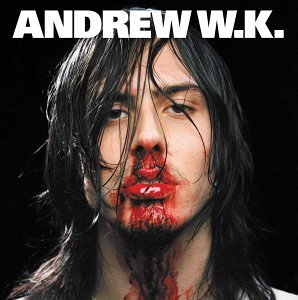
Andrew W.K. was that rocker dude in the early 2000s who wore all white, talked in insane tongues, wrote infectiously catchy rock songs like Party Hard and She is Beautiful, and was supposed to be the golden saviour of rock, only for his career to fizzle out after his third album was never released in North America.
Well apparently, there have been rumours going around that Andrew W.K. might not be real after some cryptic comments he made during a lecture about how he isn't the same person now as he was back then. Collages have been made comparing his early pictures to more recent ones and, although the similarities are there, there are also just enough differences to believe that he just maybe isn't the same guy. Thus, it has been speculated that Andrew W.K. is a fictional character that his record label created and has been played by different actors over the years.
Anyway, whether Andrew W.K. is real or just a character isn't the point. What matters is that this got me thinking about another big celebrity in the movie world who may just be a fictional character played by someone else. Check it out:


Could Michael Bay really just be Michael Bolton in disguise? You decide.