Tuesday, December 14, 2010

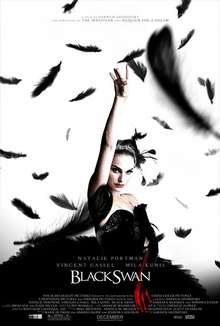
Black Swan + The Celebrity Connection: Natalie Portman


The story of Swan Lake: A princess is turned into a swan. True love is the only thing that can break the curse but her love is tricked and falls instead for her evil twin the Black Swan. The princess, who cannot live with the curse and cannot live without love frees herself through death. In a sense, this is the story that director Daron Aronofsky has been working his entire career towards telling. The film may revolve around the trails of a ballerina but Black Swan is no more about ballet than Requiem for a Dream was about drug abuse: it’s about a character chasing an impossible dream outside of their human grasp. That’s what all of Aronofsky’s films have been about.

One of Aronofsky’s great attributes is that he isn’t afraid to follow his characters unapologetically into their own oblivion and thus Black Swan isn’t so much a film as a memorizing thought piece constructed of ideas, fears, hopes and despair that doesn’t so much tell a story as ram headfirst right through a character’s psychological state as it dissipates under mounting pressure. Rarely has self-destruction been so hauntingly beautiful.

Natalie Portman stars as Nina, the naive, precious ballerina who lives with her overbearing mother (Barbara Hersey) who gave up her own career and now lives vicariously through her daughter. Nina, having dedicated herself entirely to the perfection of her art, wants nothing more than to be cast in Thomas Leroy’s (Vincent Cassel) newest rendition of Swan Lake. Leroy, a fierce, sexual, genius, knows that Nina can play the White Swan, but believes her to be too rigid in her perfection to play the Black Swan, who’s technique needs to be lose and seductive. 

The toying Leroy, maybe out of French masochism and maybe because he sees a buried sexual frustration, casts Nina in the part regardless. She is thrilled but practice is torture as she can’t quite nail the part. She is too frigid, too pristine and too desexualized for the Black Swan. Also along to torment her is the new girl Lily (Mila Kunis) who isn’t half the dancer that Nina is but is promiscuous and dangerous and has the dark allure of the Black Swan, a temptress driving Nina slowly towards the brink. There is also Beth (Winona Ryder), Leroy’s former star who has now been forced into retirement and is hospitalized after a (intentional?) car accident as well as Nina’s mother who shelters the girl like a child, keeps her away from all other outside pressure (sex, drugs, life) and gruelingly pushes her towards the perfection she never achieved.

Slowly all of the outside pressures begin to eat away at Nina, destroying her sanity as Leroy abusing her, molesting her, degrading her in order to bring out her inner Black Swam, pushes her, along with Lily, towards discovering her dark side. She is consumed by fear and hatred and sex and even murder as she begins having hallucinations of her being transformed into the Black Swan.

On the surface Black Swan appears to be about the way an artist’s ego will slowly lead them into oblivion as they strive to find perfection and meaning in their art. That was, in a very different way, more or less what Aronofsky’s The Wrestler was about as well. However, by conveying Black Swan’s plot and by trapping it into a defined thematic explanation is to subvert away from the hectic, driving, narrative free fall that the film is. Like Requiem for a Dream, Black Swan is more experience than story (this is filmmaking as state-of-mind at its most forceful and, at times, unbearably painful), and is thus more a meditation of how we are slowly driven insane by reaching desperately to achieve the things that are least important in life: fame, money, recognition, perfection ect.

Aronofsky, throughout his career, has always chosen the perfect mediums from which to explore these concepts: math, drugs, cancer, professional wrestling and now ballet: all areas that place value on superficial endeavours and distract from life's essentials: love, friendship, happiness. These are the arts of self-destruction. He makes films about people who are exposed to a plane of their existence that is foreign to them, sending them spiralling into an obsessive state until they have cut themselves off from anything that could provide them solace.

What Nina finds is that to split a personality down and limit it to the influence of either black (Leroy and Lily) or white (her mother) is to create a weak emotional state in which, when one is introduced over top of the other, it will ultimately consume and destroy it’s counterpart. In Black Swan, Nina is ultimately on a quest to find perfection at any cost just to discover that perfection can only be achieved through a sacrifice more grand than anyone should normally be willing to make: a complete and utter sacrifice of the self.

And so Black Swan cannot simply be spoken about in terms of aesthetics, technique, acting, writing: the general pieces that comprise a film, which I have not done here, because it is more than film. It is emotion, expression, ideology and, above all else it is violent, unapologetic rapture. This is one of the year’s best films.

An now a related Celerity Connection:

Could Natalie Portman really be Dakota Fanning in Disguise?
You Decide.

Thursday, December 2, 2010

Love and Other Drugs

One of Chef Gordon Ramsay’s most fundamental rules is that simplicity is key to creating a great dish. That’s kind of what goes wrong with Love and Other Drugs: it tries too hard to be too many things. It’s a good movie lost amidst a sea of variables that all go several different directions of nowhere. The biggest problem is that Maggie (Anne Hathaway) the lead female character has a disease and there is only one reason for any character to ever have a disease in the movies. If you can think of another you’re already way ahead of Love and Other Drugs.


Jamie Randall (Jake Gyllenhaal) is a hotshot youngster. He’s the son of affluent parents, has a rich entrepreneur brother, and is an expert salesman, selling cheap knockoff electronics where he divides his time between getting commission and getting the manager’s girl in the back room. Out of work he decides to pursue a career in the only entry level job in America that pays over 100K in the first year: the sale of pharmaceutical drugs.

It seems like a perfect fit for Jamie so he’s shipped off to Ohio to prove himself. The key is to go in to the doctor’s office, woo the receptionists and nurses, get your drug samples on the back shelf and charm the doctor into prescribing your Zoloft instead of the competition’s Prozac. If you’re good you attain the dream of getting shipped off to sell in Chicago.

Then, pretending to be an intern at one of the offices, he meets Maggie who has all kinds of problems, which right now includes a weird mark on her chest. She’s the kind of girl who’s young, too smart, too beautiful, talks like a second rate Woody Allen movie and has the first stage of Parkinson’s. Too bad for her. Too bad for the movie too. She’s mad after she exposes herself in the examination room only to find out he’s a drug rep not an intern. He asks her out. She rejects. He charms the nurse into her number and she accepts. A word of advice to all movie characters: if you meet a girl on a first date in a coffee shop that plays Dylan in the background, she’s probably got baggage. This leads to a scene in which she psychoanalyzes him to his face as if she knows every trick is his con book. But so do we, trapping Hathaway in a scene that talks like it's smart but walks like it's just treading water.

She doesn’t want a relationship because she’s, of all coincidences, already had her heart broken by another drug rep who just so happens to be Jamie’s biggest competition. Sure. He’s also emotionally reclusive because to him girls are sex not love. So they have sex, which works for both of them, many times, until Jamie decides he loves her and she decides, against her better judgement to reciprocate. This changes the movie from light comedy to romance until she visits a Parkinson’s rally and realizes there are others just like her. This is around the same time that he realizes the worst is yet to come and if he ever wants to make Chicago (a strong likelihood after he gets the chance to start selling Viagra) he’ll need to ditch her or cure her, and the movie switches hats again into melodrama.

I’m pretty sure, if you know anything about the politics of screenwriting, despite all the shifts in tone, you can tell exactly what twist the story will take before arriving at its inevitable conclusion. What you may not anticipate is a pre-third act breather in which Jamie and his recently kicked out of the house brother, transported in from another movie altogether, are invited to a pyjama party by Dr. Stan Knight (Hank Azaria) and his oversized libido. The one demand: they bring the Viagra samples.

Of all the sidetracks Love and Other Drugs takes this one is the worst. For a movie that feels long at two hours, a midway pajama party that ends in the hospital after a Viagra side effect takes hold, kills the tone, changes the mood to slapstick before materializing back into sap and achieves really nothing of any narrative significance. Did Zwick, a considerable talent, hold the scene so close to his heart that he simply threw it up in the air to see where it would land? There always seems to be at least one bad scene in even the best Zwick movies. He outdid himself this time.

That’s basically the entire movie, which runs back and forth and up and down the emotional spectrum until it arrives at it's end having achieved nothing much except filling 2 hours. A movie about a drug salesman could be good. So could one about a girl in the beginning stages of an incurable disease and sure enough both Gyllanhaal and Hathaway make a likable pair. They are cute and funny and believable together and left to swim on their own in an open sea of muted comedy and tired melodrama. There's nothing to prescribe that could have cured a movie like this, but like most prescription drugs that need sales reps, another round of rewrites and one more trip through the editing room may have eased the pain a little.

Wednesday, November 24, 2010

Unstoppable

Unstoppable is a rip snorting, hit-the-ground-running, peddle-to-the-metal kind of endeavour. It’s one hell of a thriller and maybe even the entertainment of the year. On paper it doesn’t sound like much but if what you’re looking for is speeding trains crashing through things as frantic people try to stop them before they strike complete disaster (and why shouldn’t you?), this one’s got just about all your bases covered. You really couldn’t ask for better.


Frank (Denzel Washington) is the old railway man who’s just been served his walking papers. As irony would have it, they come to him the same day that he is partnered up with some new kid Will (Chris Pine) who got the job, not because of his proven skill but because he is young, willing to take the pay and is related to the man who signs the cheques.

Will will be the conductor as the duo make their transport across Pennsylvania; those idyllic PA Mountains providing much of the film’s naturalistic backdrop. Meanwhile, at another yard, a train is sent off on it’s own after two morons, lazily break code in order to make their lives a little easier as one decides to jump out of his moving train to hit a railroad switch and sees the train drive off without him. Everything should be fine in theory, for the automatic brake should kick in, but of course, genius didn’t set the brake properly and the empty train barrels down the tracks at high speeds towards Stanton, and possibly the biggest disaster in PA history.

The advice of the station master (Rosario Dawson, providing so much presence from so little character) is to derail the train which, to add insult to injury, just so happens to be carrying highly toxic and explosive chemicals. There is a large patch of open country before the train hits endless civilization in which to derail the beast but the brass don’t quite take to the idea of wrecking millions of dollars of equipment. Their plan instead is to have a senior railroad man come up from the front and slam on the breaks while a marine is brought in by helicopter to drop down, climb inside and hit the breaks. It doesn’t work out much like that.

So the train barrels on towards catastrophe, destroying everything that is intentionally and unintentionally put in it’s path until Frank, with nothing to lose, decides that he and Will will chase the runaway backwards, catch it, hook it on to their breaks and save the day.

All of this is done with shameless glee by director Tony Scott, who, as with his past indulgences into excess, throws every trick in the book into the mix and then throws in the whole book as well. His camera spins and twirls and goes under the train and over the train and flies around the train with what seem like 100s of cuts per second. And yet unlike films like Man on Fire or Domino, here Scott feels like he has found a home for his aesthetic eccentricities. As the train barrels forward and his heroes barrel backwards after it, Scott manages to create real, clutching the hand-rails kind of white knuckle suspense. There is real danger here. Lives could be lost with one false move. Scott, by keeping thing hectic, never lets up on bringing that unnerving reality home.

Maybe that's because Will and Frank look like real heroes who are chasing a real train that is really out of control. If there are computer assisted effects at work here they are none that can be easily spotted by the naked eye. Thus all of the action feels plausible and for an hour and a half Tony Scott lets us know exactly what it might feel like to be in the midst of sudden death at top speeds. It’s an exhilarating ride. The film doesn’t pack the procedural punch of Paul Greengrass’ United 93 or The Bourne Ultimatum but he still manages to laugh in the face of big, dumb, artificial action movies and gives these kids a taste of how it’s really done.

Unstoppable doesn’t reinvent any wheels, doesn’t do anything that hasn’t been done before even, but it does it so well that it hardly even seems to matter proving that, sometimes it’s not about breaking the trails, but knowing the old ones better than anyone else.

Sunday, November 21, 2010

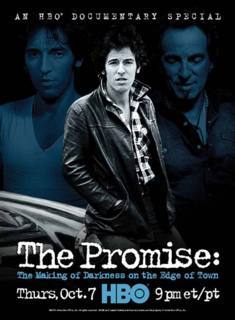
One Minutes Review: The Promise: The Making of the Darkness on the Edge of Town

I believe in the power of not knowing. Knowledge may be power but ignorance is also bliss and you know how it goes. It always comes back to Fellini's 8 1/2 for me and those first 10 minutes (maybe the greatest ever put on film) as Guido leaves Earth and flies towards the heavens, the only thing connecting him to reality being the rope around his foot, held by his producer on the beach. I could look up how Fellini did it with a quick Google search but the less I know about it, the more special it is. It's kind of like a magic trick, which is amazing on the principle that something outside of human possibility has happened. Once the trick is explained and the reality is revealed, the magic is gone.

Maybe that's, on an intellectual level, one of The Promise's biggest flaws. The Darkness on the Edge of Town was one of Bruce Springstreen's greatest albums, which, by turns, means it was one of Rock's greatest albums. It's making is the stuff of legend: Springsteen rises to superstar status off the back of his breakthrough album Born to Run, struggles with the concept of being something (an icon) that he doesn't want to be, is embroiled in a legal battle with his manager that keeps him out of the studio for 3 years as fans anxiously wait to see what this boy wonder will cook up next, and so on.

The Promise however, composed of old black and white studio footage as well as current interviews from The Boss himself and his E Street Band members, only proves to make everything about that seminal album (so lean and stripped down compared to its predecessor) seem terribly normal: a bunch of guys in the studio jamming, recording, writing. How could a period of such mundane routine produce such a profound work? Maybe it's a question the film should have left well enough alone.

What's most interesting is Springsteen himself, who, unlike his image as being the working man's rock star, is quite and awkward and introspective; sometimes to the point of being pretentious. He rarely every looks towards the camera, preferring to divert his gaze to the floor more often than not, and is quite, self-reflective and serious. Even on the moments when he cracks a smile or emits a laugh it seems to be one of insecurity and doubt as if he's still the awkward kid who never quite got around to realizing he's one of America's most valuable songwriters.

The film itself, aesthetically speaking, is no more than a feature length bonus feature that record labels used to throw in on special edition albums when record sales were in a freefall. You can't fault the film entirely: someone as mythic and legendary as Springsteen could never be done justice, but you get to wishing that if it was only going to go halfway that it wouldn't have gone at all.

PS - Could Darkness producer John Landau actually just be Steven Soderberg in disguise? You decide.

Monday, November 8, 2010

One Minutes Review: Legion

What's remarkable is not how bad Legion is but how bad the reviews of  it were, in so much as that critics approached it like it was a serious film, up for some sort of serious consideration, to be judged with serious critical tools. Critics said it was too talky; it lost it in the third; it was silly; it didn't have enough action. Really? This about a film in which, I kid you not, angels from Heaven possess the bodies of humans and turn them into profanity spurting creates? It has a spider-like ice cream man for God sake. Have movies become so polished and lifeless that critics can't spot a true howler when they see one anymore?

In fact, Legion is the best kind of bad. Sure, it's garbage, but so is Troll 2 and I'd never warn anyone away from that title. Yes, Legion exists in that special realm of serious films that approach stupid with a straight face and don't even seem to know it. It's the kind of film that doesn't have a brain in it's head but still thinks it's good anyway. Under some sort of strange reverse logic, this may actually make the movie, I don't know, kind of good? It's certainly more interesting that those big, bland, polished, empty-headed turds. Did I mention the ice-cream man?


Why the human race is being infected by angels, which essentially make them into vampire zombies, is never quite explained. Neither is why everyone in the world seems to become possessed except the handful of characters who stay stranded in some diner in the middle of nowhere. Among them is Tyrese Gibson who approaches his zingers with the ferocity of stand-up comedy. How about this nugget after a strange old woman swears up and down, bites a man in the neck and crawls up a wall and across the ceiling: Dennis Quaid can't believe that the woman wasn't killed by the frying pan he knocked her over the head with. Tyrese: "I don't give a f**k how long she been dead - the bitch just walked on the ceiling. She ain't staying in here." What about this one: when asked about the swarm of flies that mysteriously appears, "How am I supposed to know? You're asking me to explain the behavior of a muthaf**kin' pestilence?" Let's not even talk about the man hung upside down from a cross who explodes into a ball of toxic slime. What happened to his guts? Nevermind.

So yes, the movie is stupid, but it's that special kind of stupid that makes you grab your forehead in disbelief that such amateurism could exist in such sophisticated times. Oh yes, and Paul Bettany is an angel who comes to Earth to protect a child who could, for reasons known to no one but him, end the world, two guns at a time. Bettany will also star in director Scott Charles Stewart's next movie Priest as well. It's about a priest who disobeys the church in order to track down the vampires who kidnapped his niece. So there you go.

Sunday, November 7, 2010

Hereafter

To believe in the afterlife is not necessarily to believe in God. It is, instead, to believe in something. That is, after all, the reason we believe in anything isn’t it: in hope that, no matter how things are now, there’s always something better just up ahead and around the corner? Some feel that death is what makes life important. If you think about it, depending on where you stand, it’s also what makes life insignificant. We live and then we die. It’s not glamorous. Maybe that’s why we need to believe in something after death: if this is it, most of us would probably demand a refund. That’s one of life’s little contradictions: the reality of death makes us live a little better while it also means that everything we do here is essentially meaningless. Sure, some could leave a timeless legacy behind but, all the same, at the end of the tunnel there’s only one choice and it’s the same for everyone. Hereafter, Clint Eastwood’s newest directorial effort, isn’t much more profound than that, which is, so to speak, about as profound as it needs to be.

The film follows three people whose lives are all affected in some way by death. The first is TV newswoman Marie (Cecile de France) who, while vacationing is caught in a tsunami. By the time she washes up on dry land she is assumed dead but jolts back to life after experiencing a blurry vision of shadowed figures shrouded in bright light. The experience leaves her distracted and having visions of a possible afterlife. Her producer/lover tells her to take a break from work and write the book she’s always wanted to. However, so changed is she that her writing and research begins jeering toward exploring the possibilities of an afterlife.

The second is Marcus (played by twin brothers George and Frankie McLaren) who is taken away from his drug addled mother after the accidental death of his twin brother Jason. Put in foster care and seeking some kind of understanding on why his brother, the leader of the two, needed to die, Marcus travels from psychic to psychic, only to be handed cheap entertainment value and no real answers.

The final is George (Matt Damon), a man who, as a child, had a crippling disease which required surgery that left him dead for several moments on the operating table. After his recovery he was plagued by visions of the dead. He was diagnosed as partially schizophrenic and put on pills, which made the visions go away along with just about everything else as well. His brother Billy (Jay Mohr) makes him into a famous psychic until George cannot take it any more, gets a job as a labourer and starts taking cooking classes. Despite Billy’s belief that George should use his gift to help people, a life focused entirely on death is not a life at all to George who believes himself to be cursed by this burden that restricts him from forming any normal, meaningful relationships in his life.

It is then only natural that these three stories will all converge in one way or another. But this isn’t a film driven by plot gimmicks or convenient red herrings. Instead Eastwood and his writer Peter Morgan (The Queen, Frost/Nixon) play it straight, weaving a subtle tapestry that looks at death honestly and thoughtfully. This isn’t a film about spirits or hauntings, it’s a subtle human drama about how death shapes our perceptions of life as Eastwood gently builds up questions about whether or not the afterlife even exists. Is everything a product of chance or fate? Does the ability to communicate with the dead provide proof of Heaven or God or is such an ability just a condition of the mind to begin with?

What is most remarkable about Hereafter is then the subtly and yet depth with which Eastwood approaches his material: never resorting to pseudo-philosophy or providing answers to eternally unanswerable questions.

Many people will be turned off by this. The human mind has a natural reflex to instantly fill in the blanks and find artistic meaning in everything. “But what’s the movie about,” many will shout. It’s about one scene. I’ll describe it for you. Despite the fact that, because the movie has no twist or deep mystery to discover, this description hardly constitutes giving away anything important, I’ll still throw out a spoiler alert for those who have not seen the film.

The scene takes place between George and Marcus. George has reluctantly agreed to give the kid a reading in order to contact his brother. George acts as the medium but after a while loses the signal. “Where did he go?” The kid demands. “I don’t know,” replies George.

It’s one of those brilliant Clint Eastwood scenes, so subtle that they could be mistaken for nothing and yet are still the heart of the film, concealing such dramatic revelation, in which the faces of two characters, both half obscured by darkness, are intercut. They are physically divided and yet symbolically singled, sharing, for one moment, a common metaphysical bond.

And that’s it, the truth of all three characters: “I don’t know.” That is, after all, to paraphrase Socrates, all we every really know about anything anyway.

Monday, November 1, 2010

The Celebrity Connection: Chris Sarandon


These days Chris Saradon looks like this (like he could be an extra on a Pirates of the Caribbean flick). But once upon a time his locks flowed, his eyes gazed and his power of seduction was strong. He's best known as Prince Humperdink in The Princess Bride or the talking voice of Jack Skellington in A Nightmare Before Christmas, but back in the 80s, in horror movies like Fright Night and Child's Play he looked like, well:


Could Chris Saradon just be Eric Roberts in disguse? You Decide.