Wednesday, June 22, 2011
Retro Review Transformers: Revenge of the Fallen
The late Gene Siskel used to say that a movie needed to be more interesting than a documentary about its actors having lunch. Now, in 2009, a new method of thinking is needed. A movie needs to be better than playing a video game based on the same material. Or, how about one just for Transformers? A movie needs to be better than playing with the toys that it is based on. Take your pick. The moral of the story is that Transformers: Revenge of the Fallen isn’t much more than a video game minus the interaction. It is a big, loud, stupid, uninvolving, empty movie in which the action sequence reins supreme and all else is subordinate to it. It's the kind of movie that, if not firing on all cylinders, isn’t firing at all.
What’s left is a head-on collision of non-stop special effects and pyrotechnics, aesthetically comparable to a train wreck with about the same amount of emotional and intellectual depth. You could cut every character scene out of the film and wouldn’t lose much. Come to think of it, you could cut any whole section out and would be no worse off. Not a good sign at two and a half hours of running time. Allegedly the screenwriters on the film (three of them) were paid 8 million dollars for their work. Times must really be tough if, or so it would seem, 8 million barely gets a screenplay out of the planning stages.
This, under the obsessive, excessive hand of sometimes great action filmmaker Michael Bay is not filmmaking. It is instead an exercise in physical, mental and intellectual endurance, created in order to satisfy the narrow minds that need as many visual jolts as there are frames per second. A film built, not from artistry, but to fill a demand for faces to put on t-shirts, and coffee mugs and lip balm, and so on; to sell soundtracks and special editions of DVDs and toys. Who needs a story, or characters, or even coherence for that matter, when you have tie-ins?
So the story: Why bother? There is no story here, there is barely even a script, and what’s there is buried so deep amid piles of useless action that it ceases to be comprehensible. It's something about the evil Decepticons wanting to destroy the sun maybe? There is a certain point where, when assaulted endlessly, the senses simply shut down and cease to decipher what is going on. Revenge of the Fallen is a two and a half hour blur of noise and colour.
But now, isn’t this stupid, after the events of the first film, the humans and the Autobots have formed a coalition to protect Earth from Decepticon attacks. This is kind of funny considering how infantile the humans and their weapons were against the Decepticons the first time around. Why are the humans even in the film? All this proves is how useless their presence actually is to the Transformers franchise. Their three possible functions are: fire ceaseless rounds of ammunition to no avail. deliver bad sitcom punch lines or run away from expositions. Sometimes, during particularly ambitious moments, they do all three at once.
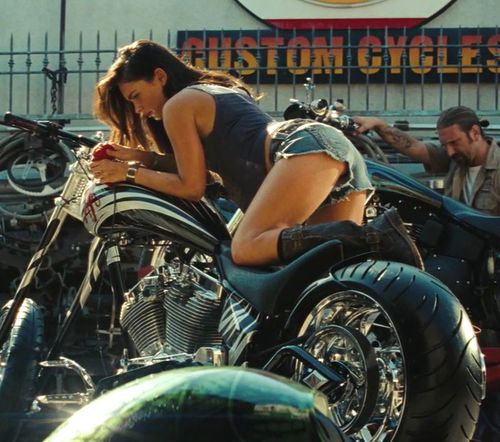
The humans are played by Shia Lebouf who is working below his rank when he deserves the kind of fast, intelligent roles James Woods used to get and Megan Fox, the extent of whose talent as an actress is pretty much summed up during the first scene she appears in here. These characters contribute nothing to the already non-existent plot, but are along for the ride out of default: they were part of the first film. But really, any human character could have been played by any actor and it wouldn’t have made any difference.
Transformers: Revenge of the Fallen is too big, too bloated, and too ambitious for its own good. It doesn’t stop to breathe, to develop its characters or at least give reason why they even need to be present in the first place, and doesn’t have time enough to at least create Transformers for us to care about. Think about it. The robots really aren’t that interesting. On their own, only about 5 or 6 of the dozen plus have discernible personalities and when engaged in battle they are simply a smear of spare parts, welded together in combat that flashes by so quickly that the eye can barely focus on it before it’s gone.
To top it all off, the film itself is just sloppily made with some scenes throwing continuity between edits right out the window. What was fun the last time around now feels like a bloated, lazy over-indulgence. It's as if Transformers has become such a huge franchise that fans wouldn’t even care if the film was made well as long as things blew up real real good.
There is, however, one very entertaining moment in the film, possibility providing an example of the problem with all of the human elements of Revenge of the Fallen. After the Witwicky home is overcome by Transformers made out of common household appliances, the Autobot, Bumblebee, who is hiding in the garage, comes to the rescue and shoots half the house to smithereens. After the incident, one of the characters talks about how they can’t tell anybody about what happened because the Transformers must be kept secret for the benefit of national security. Forget national security. If you live in the suburbs and don’t notice a giant robot Camaro blowing away half your neighbor’s house in one swift move you may be deaf, dumb and blind, or else are in a Michael Bay movie.
Retro Review: Transformers or Is Michael Bay a Great Director After All?
I once saw Martin Lawrence a few years back on the Conan O’Brien show promoting his then new film Bad Boys 2. As is usual, a clip from the film was played, this one showing Lawrence and co-star Will Smith engaged in a high speed chase over a bridge, destroying everything in their path. When the clip ended O’Brien gave positive feedback and Lawrence’s exact response was “That’s the genius of Michael Bay.” I scoffed, Michael Bay a genius? Lawrence was feeding us a line.
I was not among the minority when I denied Michael Bay the right to genius so many years ago. The director has been bombarded by fans and critics alike with every negative adjective imaginable. The man has been called a hack, a sexist, a racist, a fascist dictator, incompetent, etc. Does Bay deserve this, I must ask? Certainly he has made duds (Armageddon, Pearl Harbor), but why do film goers insist on the continual burning of effigies at the alter of Michael Bay, as though he is the antithesis of everything that is good about the cinema? It’s as if the man has single handedly lowered the collective I.Q. of every being who has ever sat in front of one of his films. Do these films really have the same kind of sway that Mites and his magical touch did or something?
The question then is, is Bay a great director? I now understand what “genius” Martin Lawrence was talking about. In an interview, Bay once said that he tells his writers that whenever they want an action sequence just write “Blow Stuff Up” on the page and he will fill in the blanks. Although joking, this single statement unlocks all of the excitement and deficiencies of the cinema of Michael Bay. Unless he is given characters that are already defined and a plot that will be able to sort itself out, Bay finds himself lost in the ruins of his own excesses. However, Bay is not a filmmaker so much as he is a painter of spectacles. Write Bay a film that provides enough cushioning to hold our interest between his relentless bouts of blowing everything in sight up real good and the man is second to none. Sometimes that’s all genius takes. After all, what more could one really desire from a film about robots from outer space who have come to destroy us?
And herein is where interests begin to conflict. Michael Bay is both the best and worst director for this material. The film’s greatest asset is also its biggest detractor: that is, it’s one, big, long, never ending action sequence stretched out over the unruly span of two and a half hours.
The action is fantastic: big, loud, imaginative, exciting, never-ending and incredibly detailed. Bay went to great pains to incorporate the real with the computer generated. But the man has no control. He just doesn’t know when to stop. The entire screenplay must have been comprised solely of Bay’s three favorite words: Blow Stuff Up. There are no characters in this film, no room for actors to give performances as Bay relies, as he always does, on the simple screen presence of his stars, who are forced to go way over the top and then keep going. Every character scene is filmed with the bang-boom-slap-bang mentality of an intense action sequence. It’s great that Bay doesn’t want to lose momentum but there’s not one opening to catch a breath in the whole damned thing. If Transformers were a fish, it would drown. That’s the contradiction: it left me with a surge of excitement and a headache.
The plot, as many probably know, is based on a popular cartoon series and toy line from the 1980s in which good Transformers (Autobots) battled evil ones (Decipticons). Of course, my nostalgia over playing with Transformers as a child far outweighs the memories of actual enjoyment that the toys provided. They were clumsy and awkward, sometimes hard to transform. This of course being all undermined by the shadow of intrigue created from getting two toys for the price of one.
The film is like this too. It’s clumsy and awkward, illogical at times (if Disturbia had any thread of realism, someone would notice a transport truck and a couple million dollars worth of cars driving through the suburbs at night, would they not?), which is undermined by how exciting and action packed it is while we play. That’s the genius of Michael Bay that Martin Lawrence was talking about: to accept the illogical and make it as spectacular as possible.
Esteemed critic and film historian David Thompson once said that Stanley Kubrick knew everything about filmmaking but nothing about life. Michael Bay is kind of the same: he knows everything about action, but nothing about humanity. His films destroy everything in their sights while never even considering the many people who have lost their homes or are out of jobs because of the trail of destruction caused by the warring Transformers. Bay doesn’t care about characters who deliver sitcom jokes and soap opera melodrama at a rate that even an ADD sufferer would find excessive, he waves the American flag (quite annoyingly) at every chance he gets and destroys so much property that one almost feels urged to have him brought up on charges of assault to the senses. So much so in fact, that when Optimus Prime as a transport truck, rolls out of an alleyway during the film’s climax, knocking stacks of crates and boxes out of the way, I thought to myself: Now, that’s just excessive.
Monday, June 13, 2011
The Celebrity Connection - Justin Beiber
I just happened to catch a picture of Justin Bieber at the MTV Movie Awards, accepting an award for something (I don`t know because I couldn`t be bothered to watch) and it struck me that the mini prima dona, who shot to fame for reasons that have everything to do with anything but talent, is sporting a new look that looks remarkably like another former child star has-been:
Could Justin Bieber really just be Corey Haim in disguise. You decide.
Labels:
Corey Haim,
Justin Beiber,
The Celebrity Connection
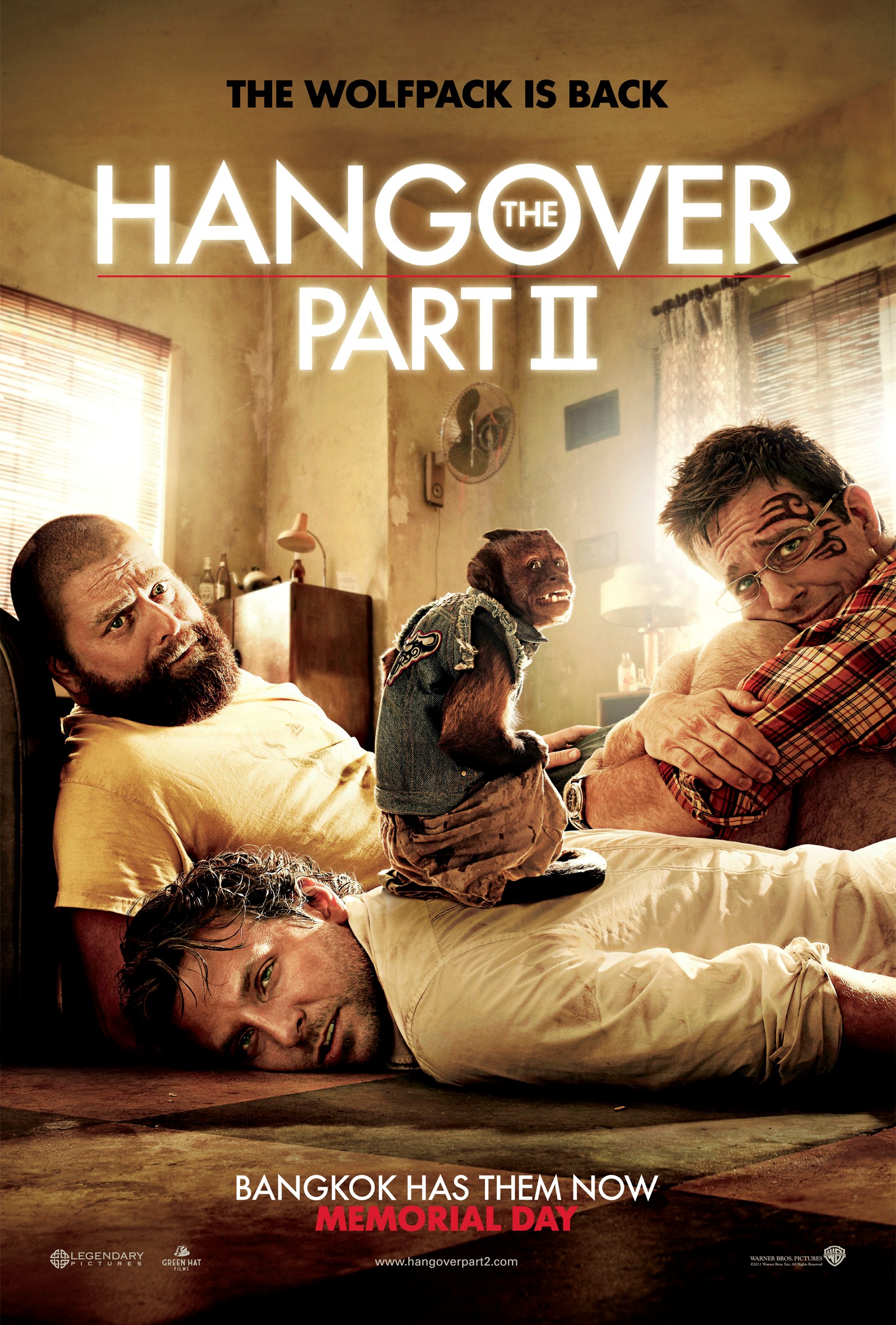
The Hangover Part 2
When a run ragged Bradley Cooper appeared in the first scene of The Hangover, in the middle of the desert on a cell phone telling someone on the other end how he had seriously F.U.’d it was one of the great comedy set-ups. He wasn’t kidding and, with giddy delight we were going to see just how. When Cooper appears in the first scene of the sequel to say he seriously F.U.’d again it feels like we’ve already been there and seen that. The premise is the same but the shock and intrigue is missing.
Not that director Todd Phillips and his team don’t try to keep the shocks coming but that’s just another one of the problems: most of what is memorable in The Hangover 2 is not how quick and hilarious it is, but just how far it is willing to push the boundaries of good taste for a laugh. But the laughs are few and far between, being undermined by the gross and absurd. It’s like Phillips forgot that the premise is the set-up not the punch line this time around.
What made the first film special above all else was that, although set in Las Vegas, it seemed to take place in a surreal parallel world in which a bunch of random objects came together and all fit in such a way that made perfect sense. It was darn near Kafkaesque. This time the boys find themselves in Bangkok and although everything makes sense again this time it’s not as inspired in it’s madcap schizophrenic way. By the time the film has been reduced to high speed chases away from Russian gangsters and crooked business men one gets the sense that we are looking at a film having fallen to the everything in the sequel needs to be the same but amplified school of thought.
This time out Stu (Ed Helms) is getting married in his fiancĂ©e's native Thailand. Phil (Bradley Cooper) and Doug (Justin Bartha) are invited as well as, after some pleading from Doug, Alan (Zach Galifianakas) who hasn’t stopped talking about Vegas and has pictures from that trip that probably shouldn’t have been published let alone be allowed to hang from his bedroom walls.
Also along is Stu’s brother-in-law to be, the 16 year old Teddy. The boys decide to have one drink on the beach the night before the wedding, thinking nothing could possibly happen. Then they wake up in a grungy hotel in Bangkok with a monkey, no sign of Teddy and Mr. Chow (Ken Jeong) the Asian gangster from the first film. Chow, knowing what happened to Teddy, is about to spill the beans before taking a hit of coke so big that it kills him. So they ditch the body and begin their search.
Their journey brings them into contact with a mute monk, a tattoo artist played by Nick Cassavettes which is surprisingly mild for a cameo role, a drug dealing monkey, and a club that Alan hilariously mistakes as a magic show.
Some of this is, for what it’s worth, quite funny. But it’s not enough. The movie, like the first one, pushes boundaries, doesn’t care who it is offending and will gleefully go anywhere it needs to for a laugh even at the expense of alienating just about everyone in the audience. I admired that quality the first time around as well and although Phillips has turned in a well made film, and the actors have all done their work, something just isn’t clicking. The magic of going on this journey and solving this mystery is gone this time around. The pieces are all in place but they don’t build a new enough puzzle.
Wednesday, June 1, 2011
One Minutes Review - Flipped
One of my favourite things in the movies is nostalgia. I love the idea of a simpler time where kids were sweeter and more innocent. Where you could trust your neighbour and appreciate the simple things like touching hands with the boy across the way, weeding the front lawn and climbing the old sycamore tree to take in the view from the top. And of course there was grandpa who wasn't old and senile but tender, loving and always knew how to bring all the problems together and set them back on the right foot.
I also love that moment between childhood and adolescence where nothing makes sense, everything isn't as how you imaged it to be and the only way to grow up and get on with life is to make the stupid mistakes and then reflect back; hoping you learned something and didn't do irrevocable damage.
Flipped, Rob Reiner's best film is over ten years, has all of these things. It's a beautiful postcard to the early 60s, and a sweet tale of two kids who live across the street from each other. One is Juli Baker (Madeline Carol) who is desperately in love with Bryce Loski (Callan McAuliffe) from the moment his family moves in across the street. They are both young and while playing their hands connect for a brief moment, more or less sealing their fate.
Grown up into adolescence, Bryce wants nothing but for Juli to leave him alone. His family is upper class, his father, subtly suggested to resort to the booze to make up for a missed life as a musician, is cold and demeaning while Juli's family is poor but full of love and are judged by the state of their front yard. Her father is an aspiring painter which also is greeted with scoffs across the street.
This goes on until, as events must transpire, Bryce realizes that he really likes Juli while Juli slowly realizes maybe Bryce wasn't what she had envisioned after all. This is all told in voice over as the same events are flip-flopped back and forth to be told first from Bryce's point of view and then Juli's.
And holding everything together is Grandpa (the invaluable John Mahoney) who has moved in with Bryce and who is kind, knowing and misses grandma.
All of this is sweet and innocent and doesn't hurt anyone. It takes place in a whimsical movie land which once doubled as America but now, all these years later, seems like a distant fantasy. It's exactly the kind of movie that makes you sit back, smile and remember the days when things were both so simple and yet so complicated all at once. The best days, some may argue, of our lives.
I also love that moment between childhood and adolescence where nothing makes sense, everything isn't as how you imaged it to be and the only way to grow up and get on with life is to make the stupid mistakes and then reflect back; hoping you learned something and didn't do irrevocable damage.
Flipped, Rob Reiner's best film is over ten years, has all of these things. It's a beautiful postcard to the early 60s, and a sweet tale of two kids who live across the street from each other. One is Juli Baker (Madeline Carol) who is desperately in love with Bryce Loski (Callan McAuliffe) from the moment his family moves in across the street. They are both young and while playing their hands connect for a brief moment, more or less sealing their fate.
Grown up into adolescence, Bryce wants nothing but for Juli to leave him alone. His family is upper class, his father, subtly suggested to resort to the booze to make up for a missed life as a musician, is cold and demeaning while Juli's family is poor but full of love and are judged by the state of their front yard. Her father is an aspiring painter which also is greeted with scoffs across the street.
This goes on until, as events must transpire, Bryce realizes that he really likes Juli while Juli slowly realizes maybe Bryce wasn't what she had envisioned after all. This is all told in voice over as the same events are flip-flopped back and forth to be told first from Bryce's point of view and then Juli's.
And holding everything together is Grandpa (the invaluable John Mahoney) who has moved in with Bryce and who is kind, knowing and misses grandma.
All of this is sweet and innocent and doesn't hurt anyone. It takes place in a whimsical movie land which once doubled as America but now, all these years later, seems like a distant fantasy. It's exactly the kind of movie that makes you sit back, smile and remember the days when things were both so simple and yet so complicated all at once. The best days, some may argue, of our lives.
Sunday, May 29, 2011
Pondering Kate Hudson
A couple of weeks ago, before Something Borrowed was released, I saw the cover of Ent, the Toronto Sun's Sunday entertainment section and on the front of it it featured drawings of Jennifer Aniston, Katherine Heigl and Kate Hudson with the caption saying "The Women Who Are Ruining Romantic Comedy." These three choices peaked my interest and got me to thinking about each lady's respective career. Although she's been in some stinkers, I don't think Jennifer Antison is ruining romantic comedy and she's even been in some good films including the Good Girl, Rumor Has It..., The Switch and so on. And even when the movie is bad, she's at least likable.
Katherine Heigl is in the same boat. She appears in mostly bad movies, but she maintains her charm throughout them and I don't know but I found The Ringer to be a funny comedy as well as Knocked Up. I've never walked away from a romantic comedy thinking that Heigl had ruined it but yes, seeing her generally throws up a red flag to a movie's quality these days.
Now Kate Hudson. Hudson seems to represent a special case separate of the other two in that no one but she has been in a single movie as excellent as Almost Famous and no one but she has been in so many consecutive awful movies subsequent to the fact. And unlike the other two offenders, it is usually Hudson, more often than not, who is the very worst thing about it. Here's a roll call: How to Lose a Guy in 10 Days, Alex & Emma, Raising Helen, You, Me and Dupree, Fool's Gold, My Best Friend's Girl, Bride Wars, Nine and Something Borrowed. Kate Hudson, the most promising of young starlets has been in more bad movies than some actors every get to be in period.
This poses the question: is Kate Hudson the worst leading female star in America? And even more to the fact, who do you think is her male equivalent?
Katherine Heigl is in the same boat. She appears in mostly bad movies, but she maintains her charm throughout them and I don't know but I found The Ringer to be a funny comedy as well as Knocked Up. I've never walked away from a romantic comedy thinking that Heigl had ruined it but yes, seeing her generally throws up a red flag to a movie's quality these days.
Now Kate Hudson. Hudson seems to represent a special case separate of the other two in that no one but she has been in a single movie as excellent as Almost Famous and no one but she has been in so many consecutive awful movies subsequent to the fact. And unlike the other two offenders, it is usually Hudson, more often than not, who is the very worst thing about it. Here's a roll call: How to Lose a Guy in 10 Days, Alex & Emma, Raising Helen, You, Me and Dupree, Fool's Gold, My Best Friend's Girl, Bride Wars, Nine and Something Borrowed. Kate Hudson, the most promising of young starlets has been in more bad movies than some actors every get to be in period.
This poses the question: is Kate Hudson the worst leading female star in America? And even more to the fact, who do you think is her male equivalent?
Saturday, May 21, 2011
Water for Elephants
The moral here is that it seems like there’s something decidedly old fashioned going on these days. The Adjustment Bureau was focused more on a love story than actio; Source Code put ideas first over all that boom boom pow stuf; Fast Five was a fun big budget B-movie with action sequences where one could see what was actually going on and now Water for Elephants gives us two great elements of American storytelling: Prohibition and the circus. It’s not a great movie, but it easily brings to mind the greats that made us fall in love with going to the movies in the first place.
Jacob (Twilight’s Robert Pattinson) is on the verge of graduating from veterinary school when he catches wind of his parent’s death in a tragic car crash. Distraught and lost, Jacob packs up his few belongings and heads for the train tracks. The train he hops on just so happens to belong to the circus.
Here Jacob meets two key people in his journey: Marlena (Reese Witherspoon) the beautiful star of the show and her husband August (Christoph Waltz) who is also the ruthless owner of the circus. Jacob convinces August to hire him on as a live in vet, something that those Ringling Brothers don’t have and Jacob quickly becomes August’s right hand man.
However, the relationship isn’t smooth. When August orders Jacob to repair the leg of Marlena’s star horse he diagnoses the situation as a lost cause and kills the animal to relieve it of its pain. This incident forces August to invest in a new star attraction: an elephant that Marlena and Jacob both love and bond over but August believes to be a dumb beast that better make his investment back for the struggling road show and who he treats with cruelty and anger.
As the story goes, Jacob is horrified by August’s treatment of the elephant while also falling in love with Marlena and trying to hide an affair from August that would set him off, prompting one of his favourite pass times which involves throwing passengers off the moving train.
Director Francis Lawrence and his cinematographer do a good job of capturing the beauty and magic of both the American countryside as well as the circus itself, which brings to mind fond memories of Fellini’s best films about the circus as well as Hal Ashby’s illuminating cross country depression tale Bound for Glory.
It ultimately makes sense that most of the film’s pleasure is derived from its ability to be nostalgic without becoming a simplification, which is helped greatly by present day bookends as the invaluable Hal Holbrook narrates the tale. The story itself is run-of-the-mill and drags in the centre when there’s a lot of training of an elephant that, to be honest, doesn’t have much personality. And yet the film captures the freedom and dread of a time period in which riding the rails, having no connection to anything but the next stop and the next show, was both majestic and frightening because, although freedom has it’s certain poetry, it also comes with the harsh reality that a time will come when one either has to grow up or die off.
From a technical point of view, the film’s greatest asset is the presence of Christoph Waltz, who so deservedly won his best supporting actor Oscar for Inglorious Basterds and is now, one film at a time, proving himself an invaluable presence. August is more of less the drive that keeps the story going as he represents the drama that exists between the two star-crossed lovers. What Waltz does is not so much make August a villain, as a man who so determinedly knows nothing but his own way and that way is force and cruelty. Although August is manipulative and heartless he is never evil so much as he is a desperate man trying to keep afloat in a desperate time. It’s the one human element that allows the film to rise above simple nostalgia and be good in its own right.
Subscribe to:
Posts (Atom)